Showing posts with label ben mcculloch. Show all posts

Tuesday, March 13, 2012

March 13, 1862 - A Link Between Pea Ridge and Horseshoe Bend

Gen. Ben McCulloch, CSA
Among the remarkable connections that thread their way through Southern history is the story of the son of a soldier of the Battle of Horseshoe Bend who lost his life while commanding a Confederate division that included soldiers from the CherokeeNation.
Brigadier General Ben McCulloch fell on March 7, 1862, at the Battle of Pea Ridge, Arkansas. The commander of one of the two Confederate divisions engaged in that battle, McCulloch led a force that included Brigadier General Albert Pike's brigade from the Indian Territory. Among the men in Pike's brigade were warriors from the Cherokee, Choctaw, Chickasaw and Creek Nations.

McCulloch, in turn, was the son of Lieutenant Alexander McCulloch, an officer in the army of Major General Andrew Jackson at the Battle of Horseshoe Bend, Alabama. Horseshoe Bend, many believe, started the Creek Nation on a road that would lead to its forced removal to what is now Oklahoma just three decades later. A large force of Cherokee warriors fought on Jackson's side in that battle and figured prominently in his victory.

Gun Hill at Horseshoe Bend Battlefield
McCulloch's father fought at the Alabama battle.
Fought on March 27, 1814, the Battle of Horseshoe Bend was a bloody defeat for the followers of the Red Stick movement within the Creek Nation. Led by Jackson in person, a U.S. Army stormed Red Stick fortifications at the town of Tohopeka. Most of the warriors fought to the death, prompting one eyewitness to observe that the Tallapoosa River "ran red with blood." More than 800 Creek warriors died, while Jackson's force suffered losses of 49 killed and 154 wounded.

In addition to Alexander McCulloch, noteworthy individuals on the field included Sam Houston, Sequoyah, Menawa, Major Ridge, William McIntosh and others. The famed frontiersman Davy Crockett once claimed to have been there, but was not. (Note: Crockett did fight in other battles of the Creek War).

Leetown Area of Pea Ridge Battlefield
McCulloch fell while leading the Confederate attack at Leetown.
On March 13, 1862, the New Orleans Times-Picayune memorialized General Ben McCulloch in a column that reminded readers of his father as well:

Ben McCulloch, whose loss on the field of battle will be mourned by his countrymen, was the son of Alexander McCulloch, who was a lieutenant and aid to Gen. Coffee, of Tennessee, in the battles of Talladega and Horse Shoe Bend, and who resigned his commission in March, 1814.
Ben was born in Rutherford county, Tenn., in 1814. He was a captain of Texas Rangers in the Mexican war, and was distinguished for courage and conduct in the battle of Monterey. On the 11th of July, 1846, he was appointed quartermaster, with the rank of major. He was also distinguished in the battle of Buena Vista, and as the commander of a spy company, before that battle, for a most daring and successful reconnoisance. He resigned his staff appointment in 1847. At his death he was a brigadier general, commanding a division, and chiefly composed of Arkansas and Texas troops. The 3d Louisiana, Col. Hebert, was attached to this division.

General Ben McCulloch was first buried on the battlefield at Pea Ridge, but his body rests today at the Texas State Cemetery in Austin.
To learn more about the Battle of Horseshoe Bend, please visit www.exploresouthernhistory.com/AlabamaHSB.
To learn more about the Battle of Pea Ridge,  please visit www.exploresouthernhistory.com/pearidgeindex.

Wednesday, March 7, 2012

The Battle of Pea Ridge, Arkansas - Day One, Part One

Pea Ridge National Military Park
Today marks the 150th Anniversary of the first day of the Battle of Pea Ridge, Arkansas.

Also called the Battle of Elkhorn Tavern, the engagement at Pea Ridge began when the morning of March 7, 1862, revealed Major General Earl Van Dorn's Confederate army moving in full force around the right flank of Major General Samuel Curtis's entrenched Union army.

Having fought with Federal troops near Bentonville the previous day and then sending part of his force up the Telegraph or Wire Road after them to keep up the impression that he intended a frontal attack on the Union army, Van Dorn moved out on a long, difficult and exhausting night march via a route called the Bentonville Detour. This road passed was a cut-off of sorts that connected Bentonville with the Telegraph Road just north of the Pea Ridge Battlefield.

Gen. Ben McCulloch, CSA
Van Dorn's plan was to strike Curtis on the right flank and rear. The commanding general himself accompanied the division of Major General Sterling Price, which followed the detour all the way around the Union army until it struck the Telegraph Road. In heavy force, Price and his men then began an advance south towards Elkhorn Tavern intending to hit Curtis from behind.

The other division was commanded by Brigadier General Ben McCulloch. He was to hit the right flank of the Union army as Price came down to strike it in the rear. If all went well, Van Dorn would smash Curtis and either force his surrender, put his men into flight into the mountains where they could not be supplied or drive them into Little Sugar Creek, which they were facing.

It didn't go as hoped. The road was long and hard and conditions were bad. The Confederate infantry spent the night trudging through cold mud and shivering in the winter weather of the Ozark Plateau. The supply wagons were far in the rear and as the march continued through the night, the distance between them and the main fighting force grew and grew.

Gen. Samuel Curtis, USA
Sunrise came and Van Dorn was not in position to begin his attack. The Federals observed his troops moving around their right and began to adjust accordingly. Even so, the surprise move almost ended in victory for the Confederates.

Convening a meeting of his officers at the tent of Brigadier General Alexander Asboth, Curtis ordered his commanders to begin a complete change of front of his army. This was a remarkable thing to attempt under any conditions, but with an enemy attack pending it was intensely difficult and dangerous. The Union commander, however, had no choice.

Col. Grenville Dodge, USA
As this meeting was underway, a courier arrived to report that Confederate troops could be seen moving in force along the Ford road to the west. Colonel Peter Osterhaus was ordered to move with his division to probe the movement. As Osterhaus began to move his men to the west in the direction of Leetown, a small community on the battlefield, a second courier arrived to report that a second body of Confederates was moving south in force on the Telegraph Road, aiming for Elkhorn Taver and the Union supply trains.

Colonel Grenville Dodge's brigade was just outside the tent at the time and Curtis order Dodge's commander, Colonel Eugene Carr, to take Dodge's brigade and half the Confederate force advancing down the Telegraph Road. Carr moved out promising the battle would be over in an hour.

Leetown Battlefield at Pea Ridge National Military Park
Osterhaus struck first, engaging the Confederates under McCulloch near Leetown and finding them to be in greatly superior force. Ordering his division forward, McCulloch began to push back the Federals. General Curtis ordered Colonel Jefferson C. Davis (not to be confused with Confederate President Jefferson Davis) to march to the support of Osterhaus and his men.

Almost simultaneously, Price attacked Union forces on the northern end of the battle, deploying his division out on both sides of Telegraph Road and pushing for Elkhorn Tavern. The Battle of Pea Ridge was now underway:

Col. Jefferson C. Davis, USA
...The battle raged...with terrible fury. Colonel Davis held the position against fearful numbers, and our brave troops nobly stood or charged in steady lines. The fate of the battle depended on success agaisnt this flank movement of the enemy [i.e. the movement by McCulloch against the Union right], and here near Leetown was the place to break it down. - Gen. Samuel Curtis, USA, April 1, 1862.

It in the woods and fields near Leetown that disaster struck the Confederate army. Realizing that the Federal forces opposing him were growing in strength, General McCulloch came up to view the Union lines in person before launching a major attack against them when he was shot down. So ended the life of on of the most remarkable men in the history of Texas, the South and the United States.

Gen. James McIntosh, CSA
Command of the division now fell to Brigadier General James McIntosh, but within fifteen minutes he too was shot down just a short distance from where McCulloch had been killed. He died on the battlefield, becoming the first Confederate general from Florida to give his life in the cause of the South.

Colonel Louis Hebert, of Louisiana, now assumed the command and ordered the attack. It went well at first and the Federals were driven back. Smoke, friendly fire and wooded terrain, however, created great confusion in the Confederate ranks and the attack stalled. Hebert became separated from his men and was taken prisoner.

Please click here to continue to The Battle of Pea Ridge, Arkansas - Day One, Part Two.

You also can read more at www.exploresouthernhistory.com/pearidgeindex.

Sunday, March 4, 2012

March 4, 1862 - The Confederates come down from the Mountains

Snow blankets Pea Ridge Battlefield (NPS Photo)
On the morning of March 4, 1862, 150 years ago today, Confederate Major General Earl Van Dorn marched his Army of the West out of the Boston Mountains and onto the Ozark Plateau of Washington and Benton Counties, Arkansas.

As the Confederates moved out, Brigadier General James McIntosh's cavalry brigade was ordered to take the lead. This was a standard military move. The cavalry would move out ahead of the main body to clear the roads of any enemy pickets, to scout and to secure the route of march.

Part of this movement was spearheaded by Colonel Elkanah Greer and the Third Texas Cavalry. Organized at Dallas in June of 1861, the Third Texas was a seasoned regiment, having fought at Wilson's Creek, Chustenahlah and other actions:

The Boston Mountains
     At 7 o'clock on the morning of the 4th we left our encampment on Boston Mountains, my regiment going in advance.
     That night we encamped near Fayetteville. The day had been very cold, with quite a snow-storm during the morning.  - Col. E. Greer, Third Texas Cavalry, CSA, March 1862.

The Missouri State Guard, under Major General Sterling Price, stepped off in the wake of the cavalry from its camps near Cove Creek. Price later described how Van Dorn had ordered him to march with only three days rations and supplies:

Cove Creek Road
...That officer having arrived at Cove Creek and assumed command of the Confederate forces in Western Arkansas, I gladly placed myself and my army under his orders, and in obedience to these toop up the line of march in the direction of Bentonville on the morning of March 4, provided with three days' cooked rations, leaving my baggage and supply trains to follow slowly in the rear. - Gen. Sterling Price, CSA, March 22, 1862.

The total force under Price consisted of 6,818 men with eight batteries of field artillery. General Ben McCulloch marched with a similar size force, but due to his death in the coming battle did not file a report on his movements.


Gen. Earl Van Dorn, CSA
Brigadier General Albert Pike, meanwhile, had linked up with Colonel Stand Watie's First Cherokee Rifles at Cincinnati on the western border of Arkansas and on the 4th pushed on into Northwest Arkansas to link up with Van Dorn's army. 

The Confederate army was assembling for battle and, for one of the few times in a major battle during the war, would outnumber its opponent. The Battle of Pea Ridge was now three days away.

They day and night of March 4th were bitterly cold in the mountains and, as Colonel Greer later noted, heavy snow fell, particularly in the higher elevations. Van Dorn himself was sick with fever and had been with the army less than 24 hours, but insisted on the immediate advance.The weather, the terrain and his failure to properly organize his supply system would haunt him in the days to come.

I will continue to post on the Battle of Pea Ridge over coming days so be sure to check back often. You can read more about the battle anytime at www.exploresouthernhistory.com/pearidgeindex.
 

Friday, March 2, 2012

March 2, 1862 - Van Dorn approaches the Scene of Action

Gen. Earl Van Dorn, CSA
March 2, 1862, 150 years ago today, found Confederate General Earl Van Dorn approaching the scene of the action in Northwest Arkansas.

He was in Pocahontas on February 22, 1862, when he learned that Springfield, Missouri, had fallen and that General Sterling Price's Missouri State Guard was retreating into Arkansas:

...I received dispatches on February 22, informing me that General Price had rapidly fallen back from Springfield before a superior force of the enemy, and was endeavoring to form a junction with the division of General McCulloch in Boston Mountains. For reasons which seemed to me imperative I resolved to go in person and take command of the combined forces of Price and McCulloch. - Gen. Earl Van Dorn, CSA, March 27, 1862.

Arkansas River
The magnitude of the emergency was evident and Van Dorn began to move. At the same time, the Confederate forces in the Boston Mountains continued to rest and regain their strength. Supplies flowed up from the Arkansas River and news came from west of the line that General Albert Pike was approaching with a large force of Native American Confederates. 

With Van Dorn on hand to overrule any disputes that might arise from the long-standing bickering between Generals Price and McCulloch, the Confederate army would be ready to defend itself. 

The Confederate commander had more in mind than just defense, however, and would prove it the next day. Although he was sick with fever, Van Dorn was as aggressive as ever and dreamed not just of defeating Curtis in Northwest Arkansas, but of taking Missouri and marching on St. Louis. This dream would lead him to undertake a bold gamble. He would show his hand in just five days at the Battle of Pea Ridge.

Be sure to check back tomorrow as I post on the Confederate army's advance to Pea Ridge. You can learn more about the battle anytime at www.exploresouthernhistory.com/pearidgeindex.
 

Sunday, February 19, 2012

Pea Ridge #11 - The Burning of Camp Benjamin

Gen. Ben McCulloch, CSA
Aware now that his camps at Cross Hollow could not be defended, Confederate General Ben McCulloch ordered them destroyed.

Some of the finest winter quarters of the Civil War went up in smoke and flame as McCulloch's men pulled out to withdraw into the Boston Mountains. General Sterling Price's Missouri State Guard had already pushed into the mountains.

To protect the rear of his withdrawing column and carry out the destruction, McCulloch had cavalry cross the mountains from their winter camps in the Arkansas River Valley. Among the units that came over was the Sixth Texas, which reached Camp Benjamin 150 years ago today. The troopers saw to the destruction of the solid cabins that had once sheltered Colonel Louis Hebert's men:

...I was detailed to destroy the winter quarters in the vicinity of Cross Hollow and to bring up and protect the rear of the army, which was then falling back on Boston Mountains. As the thick, curling volumes of smoke and lurid glare of flame arose from Camp Benjamin my troops doggedly turned to the duty of rear guard for the army, and maintained this position until we were encamped upon the mountain. - Unidentified Member of Sixth Texas Cavalry, 1862.

Dripping Springs, Arkansas
Following the Wire and other roads south through the mountains, the Confederates fell back to the area around Dripping Springs in Crawford County. The cavalry blocked the passes into the mountains.

The movement put the forces under McCulloch and Price into positions they could easily defend. This gave them time to halt, rest, resupply and organize. McCulloch and Price had feuded quite a bit the previous year, but now they were forced to come together for the sake of their common cause. 

The Federals did not try to follow the Confederates into the mountains, but would advance as far south as Fayetteville in coming days. Their long advance, however, was all but over. The initiative would now turn to the Southern army and its new commander, General Earl Van Dorn.

I will continue to post on the 150th anniversary of the Pea Ridge Campaign over the next few weeks, so be sure to check back regularly. You can also learn more about the Battle of Pea Ridge at www.exploresouthernhistory.com/pearidgeindex.
 

Saturday, February 18, 2012

Pea Ridge #10 - The Action near Bentonville, Arkansas

Gen. Alexander Asboth, USA
Having concentrated his main army behind Sugar Creek and pushed back Hebert's men the previous day (see Pea Ridge #9 -The Battle of Dunagin's Farm), Union General Samuel Curtis ordered Brigadier General Alexander Asboth to push forward to Bentonville on February 18, 1862, 150 years ago today.

A former Hungarian freedom fighter and the Chief of Staff who had helped General John C. Fremont organize the Union army to defend Missouri the previous year, Asboth was at his best when operating with cavalry in advance of an army. He moved quickly and efficiently at 9:30 a.m.:

...Following Sugar Creek 4 1/2 miles, I struck the Cassville and Springfield Road (which leaves the Wire road at a point 6 miles behind Sugar Creek Crossing, where the First and Second Divisions were last encamped), and after surprising a dismounted rebel cavalry picket 4 miles this side of Bentonville and taking some of their horses and all their saddles and bridles, I occupied Bentonville at 20 minutes past 12 o'clock. - Gen. Alexander Asboth, USA, February 19, 1862.

Fremont Hussars (Civil War Drawing)
The Action near Bentonville was a quick skirmish. The Union force consisted of the Benton and Fremont Hussars from the Fourth and Fifth Missouri Cavalry Regiments (US) and two pieces of light artillery under Captain Elbert of the First Missouri Flying Battery. Sweeping aside the cavalry picket outside of town, Asboth rolled into Bentonville on horseback to find the town occupied by part of Colonel Frank Rector's Seventeenth Arkansas Infantry (CS).


General Asboth (foreground) and his dog
The Confederates were removing equipment and supplies from Bentonville. There are two versions of what happened next. Major C. Schaeffer Bornstein, Chief of Staff, reported that there was a brief battle::

...After a short engagement the rebels were driven to flight, leaving behind a large amount of provisions, arms, wagons and horses. Besides that, our forces captured a number of prisoners, and took possession of their regimental flag, which they found hoisted at the courthouse. - Major C. Schaeffer Bornstein, USA, March 4, 1862.

 General Asboth reported, however, that there was no resistance in the town:

Civil War map showing Bentonville, Arkansas
...Bentonville was entirely deserted upon our taking possession of it. In a short time, however, we collected from the bushes in its vicinity about 60 men, 32 of whom, being rebel soldiers or taken with arms, I brought in as prisoners.... To the others, sick and wounded and non-combatant inhabitants of the town, I administered the oath of allegiance. - Gen. Alexander Asboth, USA, February 19, 1864.

Asboth reported that the Confederate troops from Bentonville had evacuated their camp there to reinforce the main Southern position at Cross Hollows. After doing some scouting of the area, he returned to the primary Union camps at 7:30 p.m. and presented the captured flag to General Curtis.

The taking of Bentonville with such relative ease convinced General Curtis that he could move a flanking force around to the west from his position at Sugar Creek to force Confederate General Ben McCulloch's main body from its camps at Cross Hollows. McCulloch realized this as well and immediately prepared to evacuate that position and its comfortable winter quarters.

I will continue to post on the 150th anniversary of the  Pea Ridge Campaign over coming days and weeks, so be sure to check back regularly. You can always read more about the Battle of Pea Ridge at www.exploresouthernhistory.com/pearidgeindex.

Tuesday, February 14, 2012

Pea Ridge #7 - Exchanging Valentines of lead at Crane Creek, Missouri

Valentine's Day of 1862 (150 years ago today) found the Union army pushing closer and closer to Northwest Arkansas.

General Curtis and General Franz Sigel were advancing south along roughly parallel routes, hoping to trap Price before he could escape across the Ozark Plateau and into the Boston Mountains of Arkansas. As was often the case in such movements, howevever, Curtis and Sigel had difficulty communicating.
Map showing Crane Creek, McDowell's and Cassville
Notice the route of the Wire Road connecting all three.

At 7 p.m. on February 14, 1862, Curtis dispatched a message to Sigel from McCullah's Store that his cavalry had engaged Confederate troops at Crane Creek:

...Whether he will stand there or not is very uncertain, but I think it will be hard for his train and heavy artillery. He will probably move on through. I will try to attack him in rear to-morrow, but will delay if he stops until you can reach him. I regret that I can get no report from you, but hope you got my reply to yours this morning. I find one or two companies of Benton Hussars here, and will take them with me, as the nearest and best way for them to rejoin you. I hope you are able to reach the enemy or strike his flank at McDowell's since he is now probably passing Crane Creek. - Gen. Samuel Curtis, USA, February 14, 1862.

Gen. Franz Sigel, USA
Crane Creek is located in Southwest Missouri about half-way between Springfield and the Arkansas line. The modern town of Crane sits on the creek, which is a trout-fishing draw for anglers from throughout the region.

The Union cavalry by February 14th had penetrated the country 30 miles below Springfield and the Missouri State Guard was on the verge of being forced entirely from its home state. By road Curtis and the advance elements of his army were now 49 miles from Arkansas.

McDowell's, where Curtis hoped that Sigel would be able to strike Price from the flank, was about 20 miles southwest of Crane Creek between the modern cities of Cassville and Aurora.

General Sterling Price, meanwhile, was moving rapidly hoping to escape the attempt by Curtis and Sigel to trap him with their pincer movement. His main body spent the day pushing south on the old Wire Road, aiming for the Arkansas border and the support of General Ben McCulloch's forces in Washington and Benton Counties.

I will continue to post on the 150th anniversary of the Pea Ridge Campaign over coming days, so be sure to check back often. You can read more about the Battle of Pea Ridge anytime at www.exploresouthernhistory.com/pearidgeindex.

Thursday, February 2, 2012

February 2, 1862 - "The snow here has been a foot deep"

Col. Louis Hebert, C.S.A.
The letter that follows was written by a Confederate soldier stationed at Camp Benjamin in Northwest Arkansas on February 2, 1862 (150 years ago today).
The man identified himself only as "T" and was probably a member of Colonel Louis Hebert's brigade.

Camp Benjamin, according to an account by Surgeon Washington L. Gammage of the Fourth Arkansas Infantry, was two miles southeast of Cross Hollows and two miles east of the main road connecting Fayetteville and Springfield in Benton County, Arkansas. Gamage described the camp as being in a "narrow, level valley, bounded on the north and south by a high range of hills, and supplied with an abundance of pure sparkling water by a mountain stream, which was of sufficient size to support a grist mill where the corn and wheat which the neighboring farms supplied in abundance."

The soldier's letter provides good insight to the mindset of Confederate soldiers in Northwest Arkansas during the early days of the Pea Ridge Campaign:

Thinking perhaps a line from this section might be acceptable, I write you a line from our lonely winter quarters. We are situated twenty miles east of Fayetteville, in a hollow, surrounded on all sides by high hills, and as freefrom any society except our own forces as we would be in the deserts of Arabia. The daily routine of camp duties is all there is to relieve our monotonous life. My duties confine me very close to my quarters.

We look for stirring times, however, on the opening of the spring campaign. Our General, McCulloch, has returned to command us, which gives universal satisfaction. It would have beeen a great misfortune to this brigade if Price's newspaper friends had succeeded in displacing our General. I fear our brigade would ahve been completely demoralized. McCulloch is beloved by officers and men, here, as a prudent, careful and brave officer, and those who know him best love him most.

Our regiment is looking forward with much interest to the time (17th May,) when we are to be permitted to see our friends at home once more. We are willing to "fight on, fight ever," as long as the war and life last; but we would like, if possible, to go home first.

The snow here has been a foot deep on a level the past week, and the weather intensely cold. To-day it is sleeting and raining by turns, while icicles hang from the eaves of our houses four feet long. We are in comfortable quarters. Three regiments being quartered here it looks like quite a village. The houses are built uniform, 18 by 36, two rooms in each, and about one hundred and fifty houses in all, laid out in regular streets and avenues, in military style, the regimental and staff forming a square at the head of each regiment.

The entire regiment is well clothed and healthy.

A marker for the Confederate camps at Cross Hollows is located at the corner of Cross Hollow Road and Old Wire Road, near Rogers and between Fayetteville and Bentonville. The actual hollow runs from just north of Lowell east into what is now Beaver Lake.

I will continue posting on the 150th anniversary of the Pea Ridge Campaign over coming days, so be sure to check back often. You can learn more about the Battle of Pea Ridge at www.exploresouthernhistory.com/pearidgeindex.

The map below shows you the Cross Hollows area as it appears today.

View Larger Map

Monday, January 30, 2012

January 30, 1862 - The Union Army Begins its long slow march to Pea Ridge

Historic Photograph of the Missouri Ozarks
Library of Congress
Newspaper readers across the Midwest learned 150 years ago today that the long anticipated southward movement of the Union army in Missouri was underway.
The positioning of Colonel Jefferson C. Davis and his Division (not to be confused with the Confederate President) was a sign that General Samuel Curtis was beginning a slow drift to the south that would pick up speed over the coming days and weeks:

The movement foreshadowed by the preparations at Otterville of the past week has taken place. One division under the command of Jeff C. Davis has already taken up its march for the South. They left Versailles Tuesday morning. Their destiantion is supposed to be Springfield. The division consists of five regiments, the 8th and 22nd Indiana, the 37th Illinois, and the 9th Missouri, accompanied by two batteries of twenty-four pieces, and three companies of cavalry, under the command of Major Hubbard. From the skill and energy of Gen. Davis, important results are confidently predicted. The next division under Gen. Turner is expected to leave Thursday or Friday. - Springfield Republican, January 30, 1862.
Colonel Jefferson C. Davis, U.S.A.
National Park Service

It seems remarkable today that such detailed reports were printed in newspapers in 1862, but it was a common practice. The generals of both sides learned a great deal from the newspapers of the other side.

The article also made reference to an interesting report that seemed to indicate General Sterling Price and his Confederates might not might for Springfield:

A gentleman from Green county, a few miles from Springfield, who arrived at Rolla on the 24th, says no entrenchments are being built at Springfield, and but little uneasiness is manifested by Price or his officers. There is a general cry for reinforcements, and the rebels say they are on the way, but vary as to the number.... Price expects his appointment [i.e. as a regular general] will be confirmed within two weeks, when he will be reinforced from Arkansas. Unless he can take command of the whole force, he may be obliged to retreat. He has a large number of wagons, and is putting everything in readiness to decamp. - Springfield Republican, January 30, 1862.

The article predicted the future quite well. Price would retreat from Springfield, Missouri, without a major fight and fall back into Arkansas where he linked up with the divisions of Generals Ben McCulloch and James McIntosh. Together their combined forces would form General Earl Van Dorn's new Army of the West. The long road to the Battle of Pea Ridge had begun.

I will continue posting on the 150th anniversary of the Pea Ridge Campaign over coming days and weeks, so check back often. You can also read more on the Battle of Pea Ridge at www.exploresouthernhistory.com/pearidgeindex.

Monday, January 23, 2012

January 23, 1862 - Ben McCulloch's Proclamation to His Men

Brig. Gen. Ben McCulloch, C.S.A.
National Park Service
As he made his way back west to Arkansas from meetings with Confederate officials in Richmond, Virginia, Brigadier General Ben McCulloch of Texas issued a call to his troops to reenlist at the end of their 12 months service.
When the Southern states seceded in 1860-1861, few people believed that war - if it came - would last longer than one year. As a result, most of the initial regiments were formed for one year's service. As McCulloch returned to Arkansas in anticipation of renewed fighting, he realized that many of his men were approaching the end of their service.

As a result, on January 23, 1862 (150 years ago today), he issued a proclamation to the men in his ranks calling upon them to re-enlist. Keeping his experienced regiments in the field was vital to McCulloch and he made no bones about the need for his men to keep fighting:

PROCLAMATION.
Soldiers of Arkansas, Louisiana and Texas!

Your country calls on you for further service. Will she call in vain? Will the gallant men who have braved death in all its forms, now shrink from peril? Never! Never will it be said of them, they deserted their country in the hour of danger! We must re-enlist, or all the blood spilt is as water poured upon the ground. Let it not be said, our brave comrades have fallen in vain. Let us try by our acts to immortalize their memories. Their spirits look down upon our deeds and demand of us, that their names be handed down to future generations as martyers in a glorious and successful cause. Our cause is just; it will succeed. Let those who doubt it go seek a home in the North. They are unfit to live among freemen. This war cannot last. Before two years will have passed we will be a free and happy people. Then, who will not be proud to say, I was a soldier in the army that won our Independence!

BEN. McCULLOCH,
Brigadier General.
January 23d, 1862.

General McCulloch himself would soon become a martyer to his cause. He was killed at the Battle of Pea Ridge in early March.

I will continue posting on the 150th anniversary of the Pea Ridge Campaign over coming days and weeks, so be sure to check back often. You can also read more on the Battle of Pea Ridge at www.exploresouthernhistory.com/pearidgeindex.

Thursday, January 19, 2012

January 1862 - Prelude to Pea Ridge

Pea Ridge National Military Park
This year marks the 150th anniversary of the Battle of Pea Ridge, Arkansas, not just one of the largest battles west of the Mississippi, but one of the most significant actions of the entire Civil War.
As part of the commemoration of this battle that preserved Missouri for the Union, I will be posting throughout January, February and March on the Pea Ridge campaign, using as often as possible the words of the soldiers, generals and civilians that witnessed it. Be sure to check back regularly for the latest posts.

Curtis
To try to set the stage as well as I can, the Pea Ridge Campaign began to develop in January of 1862 as two armies began to assemble for battle. The Union army, commanded by Gen. Samuel Curtis, was centered at Rolla, Missouri, a town about 112 miles northeast of Springfield. Curtis was determined to drive Confederate forces, particularly the Missouri State Guard under Gen. Sterling Price, from Missouri and fully establish control over the state, which was very divided in its loyalties.

The Confederates, in turn, were equally determined not only to hold at least part of Missouri if possible, but to stop Curtis from advancing into Arkansas. In mid-January of 1862, however, their forces were scattered and had yet to assemble for battle. The Missouri State Guard, under Price, was clinging to its position at Springfield, Missouri. Gen. Price knew, however, that he could not hold there against Curtis's much larger army.

Price
The Missouri general for more than one month had been begging for help from Arkansas. A force of 3,000-4,000 Confederates were centered around Fayetteville in Northwest Arkansas under Gen. Ben McCulloch. Unfortunately, Price and McCulloch did not get along. Not only would the latter general not reinforce Price, he had gone to Richmond to discuss the situation with officials there, leaving Col. Louis Hebert of Louisiana in command. Hebert promised Price that he would reinforce him in an emergency and did his best to get supplies through to the State Guard, but otherwise maintained his force in its winter quarters around Fayetteville.

To the south in the Arkansas River valley, Gen. James McIntosh commanded a large cavalry force that was wintering around Van Burn and Fort Smith. He had declined a request from Price for help in December and gone instead to support Col. D.H. Cooper in the Cherokee Nation where he had won the Battle of Chustenahlah several weeks earlier.

Van Dorn
To try to end the confusion and bickering in the West, President Jefferson Davis appointed Major General Earl Van Dorn as head of what he would style the "Army of the West." Van Dorn was not yet on the scene in mid-January, but was heading that way. He was not thinking of just halting Curtis, he had dreams of a major offensive campaign. He told his wife on the day of his appointment that he "must have St. Louis."

To Van Dorn would fall the task of pulling together the three major Confederate forces then assembled in Missouri and Arkansas and leading them into battle. He would receive support from Gen. Albert Pike's brigade of Southern-allied Indian troops.

I will continue to post on the Pea Ridge Campaign throughout the coming weeks. To read more about the battle itself, please visit www.exploresouthernhistory.com/pearidgeindex.

Monday, January 16, 2012

The Confederate Army in Northwest Arkansas - January 1862

Col. Louis Hebert
3rd Louisiana Infantry Regiment
January of 1862 (150 years ago) found Northwest Arkansas under the command of Colonel Louis Hebert of the 3rd Louisiana Infantry.

General Ben McCulloch had gone to Richmond leaving Hebert in charge of the small army of around 4,000 men in Northwest Arkansas. From his headquarters at Fayetteville, Hebert reported in January that his men were in winter quarters. His cavalry, he noted, was in bad condition due to sickness. Subsequent Union reports would indicate that he did a good job of overseeing the hospitals of his command and that they were well equipped with mattresses, etc.

To the north of Hebert, General Sterling Price still held Springfield but was growing extremely concerned about the advancing Federal forces of General Samuel Curtis. The Union commander was determined to drive Price out of Missouri and into Arkansas. A critical situation was developing in the Trans-Mississippi and everyone there knew it.

Headquarter's House
A surviving war era home in Fayetteville, Arkansas
According to Hebert, large wagon trains carrying supplies were moving north across the Boston Mountains from Fort Smith during January, supplies that were desperately needed by Price's "Missouri State Guard." Because of the condition of his cavalry, he asked Price to send mounted troops to escort the supply trains from Northwest Arkansas north to Springfield. He also notified Price that he was prepared to move to his support should the Federal army begin moving on Springfield from Rolla, Missouri.

The stage was being set for two great armies to meet on the Ozark Plateau at a place called Pea Ridge. Price and Hebert would figure prominently in the coming battle, as would the Union commander General Curtis. The fight was just seven weeks away.

I will continue posting on the events leading up to the Battle of Pea Ridge over coming days, so be sure to check back regularly. You can also learn more about the battle by visiting www.exploresouthernhistory.com/pearidgeindex.

Friday, January 13, 2012

Ben McCulloch's Command in Arkansas

Gen. Ben McCulloch, C.S.A.
January of 1862 (150 years ago) found Brigadier General Ben McCulloch's command in winter camp in Northwest Arkansas.
McCulloch was already a hero in Texas, where he had gone from Tennessee in 1835 to link up with David Crockett's men. A case of the measles kept Ben and his brother from reaching their planned rendezvous with Crockett in time and actually saved the future general's life by preventing him from being one of the men who died with the famed Tennessean at the Alamo. He did go on to command a cannon at the Battle of San Jacinto, where Texas won its independence in 1836.

Over the next 25 years, Ben McCulloch developed a reputation as a Texas Ranger, soldier and political leader. Commissioned a colonel by Southern president Jefferson Davis, he accepted the surrender of U.S. forces in Texas on February 16, 1861. Sent almost immediately to serve in Arkansas and the Indian Nations of what is now Oklahoma, he was given his general's star on May 11th.

McCulloch defeated the Union forces at the Battle of Wilson's Creek, Missouri, in August of 1861 and by that winter had his men in position in the hills and valleys of the Ozark plateau of Northwest Arkansas. He left his camps there and went to Richmond to meet with authorities in the Confederate capital about the situation west of the Mississippi, the condition of his men and his ongoing disagreements with Missouri general Sterling Price.  The two men did not get along.

Cannon at Pea Ridge National Military Park
An account of this trip appeared in Southern newspapers in January:

...The purpose of Gen. Ben McCulloch's visit to Richmond is to superintend the procuring of arms for his command, now performing the duty assigned by Government of protecting the Indian territory and the northwestern border of Arkansas from incursions of the enemy from Kansas. Although injurious criticisms have been made by journalists who write without a knowledge of the facts, his movements and objects are well understood and appreciated by his troops and approved by the Government. He has co-operated with Gen. Price in Missouri, as far as he could do so consistently with the duty assigned him of guarding the frontier, and, so far from his army remaining inactive at present, the recent fight of a portion of it under Col. McIntosh bespeaks anything but indifference to the cause or a disposition to shrink from the dangers of the campaign.

McCulloch returned to Arkansas following his trip to Richmond and both he and Price, along with General Albert Pike, would serve under General Earl Van Dorn's command in the coming Pea Ridge Campaign and at the Battle of Pea Ridge.

You can read more about Pea Ridge at www.exploresouthernhistory.com/pearidgeindex.

Thursday, March 5, 2009

The Death of Ben McCulloch at Pea Ridge


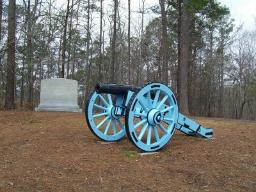
This photograph shows a row of Confederate cannon on the Leetown section of the Pea Ridge battlefield.

This was the section of the field where the Battle of Pea Ridge began, as General Ben McCulloch of Texas led thousands of men in a planned attack against the right rear of the Union lines. The other half of the Confederate army, led by General Van Dorn in person and commanded by General Sterling Price, was moving up around a mountain to sweep in directly behind the Union forces via the Telegraph Road and Elkhorn Tavern.

McCulloch was a famed figure on the frontier. Born in Tennessee in 1811, he was part of the group that was to accompany David Crockett to Texas in 1835 but came down with the measles and so was late linking up with Crockett and the other men. As a result, he missed being killed at the Alamo with Crockett, Travis and the other Texas heroes.

Outraged, McCulloch joined Sam Houston's army and commanded one of the famed "Twin Sisters" cannon at the Battle of San Jacinto. He fought in other skirmishes and battles against Mexican forces and also served under Major David E. Twiggs during the Mexican War.

During the years leading up to the Civil War, McCulloch served as a scout, U.S. Marshal, Texas Ranger and served as one of the peace commissioners sent to negotiate a truce with Brigham Young and his followers in Utah during the 1858 "Mormon War."

Commissioned as a colonel by President Jefferson Davis in 1861, McCulloch had accepted the surrender of U.S. military posts in Texas from his former commander, David Twiggs. He was then promoted to brigadier general and fought with distinction at the Battle of Wilson's Creek in Missouri.

He achieved initial success at Pea Ridge, overrunning a Union battery and driving toward the rear of the right flank of the main Union line. As he moved forward for a closer look at Union positions, however, he was shot from the saddle by a Union sharpshooter and died instantly. Reports indicate that, never fond of military uniforms, McCulloch had gone into battle wearing a black velvet suit.

His second-in-command, General James McQueen, died just fifteen minutes later when he was killed in a charge launched to recover McCulloch's body. The Confederate attack rapidly fell apart, perhaps ending the greatest possibility of success for Van Dorn's army in the Battle of Pea Ridge.

General McCulloch was initially buried on the battlefield but now rests at the University of Texas-Austin.

I'll post more about Pea Ridge tomorrow, but until then you can read more by visiting www.exploresouthernhistory.com/pearidgeindex.

Friday, March 7, 2008

Pea Ridge, Part Two - Attack at Leetown

Note: If you aren't familiar with the Pea Ridge battlefield, you can use this map from the National Park Service to help understand the sites we'll be describing over the next few days.

As he arrived with his division at Leetown to the right and rear of the Federal right flank and found the Confederates there in force, Union Col. Peter Osterhaus deployed his infantry along a treeline and sent his cavalry forward into an open field. They were quickly driven back by Confederate cavalry.

The Confederates greatly outnumbered Osterhaus and planned to launch three separate attacks on this segment of the battlefield. General Ben McCulloch planned to attack Osterhaus' infantry with his man force, while Col. Lewis Hebert moved through Morgan's Woods and struck the Federal right flank. General Albert Pike's warriors from Indian territory would operate on the Confederate right.

Gen. McCulloch rode forward to take a closer look at the arrangement of the Union lines before launching his attack. It proved to be a fatal decision. He was shot and killed by Federal skirmishers.

His second-in-command, General James McIntosh, now assumed command of the attack. He was killed less than 15 minutes later, however, while leading a regiment forward. The Confederate attack disintegrated as command and control broke down on the battlefield. Other Confederate officers had no way of knowing that both generals were dead and so no one stepped forward to assume command of the attack. Osterhaus had held.

Col. Hebert was now the division commander, but had already moved with his men into Morgan's Woods following orders to attack the Union right flank. He drove back two Union regiments and captured part of a battery, but his attack became disorganized in the thick woods. Things became so confusing that some Confederates fired into the backs of their own men.

Since the attack on his front had fallen back, Osterhaus now swung his command to the to the right and struck Hebert's flank. Another force of Union troops under Col. Davis soon attacked the Hebert's other flank and his command disintegrated. The colonel himself became confused as he tried to escape the debacle and went in the wrong direction, only to be captured near Curtis' headquarters.

The Confederate attack at Leetown had failed and two promising Southern generals - Ben McCulloch and James McIntosh - had been killed. The Battle of Pea Ridge, however, was just beginning.

Our series on the battle will continue in the next post. Until then you can read more by visiting www.exploresouthernhistory.com/pearidgeindex.