Showing posts with label alabama. Show all posts

Tuesday, March 13, 2012

March 13, 1862 - A Link Between Pea Ridge and Horseshoe Bend

Gen. Ben McCulloch, CSA
Among the remarkable connections that thread their way through Southern history is the story of the son of a soldier of the Battle of Horseshoe Bend who lost his life while commanding a Confederate division that included soldiers from the CherokeeNation.
Brigadier General Ben McCulloch fell on March 7, 1862, at the Battle of Pea Ridge, Arkansas. The commander of one of the two Confederate divisions engaged in that battle, McCulloch led a force that included Brigadier General Albert Pike's brigade from the Indian Territory. Among the men in Pike's brigade were warriors from the Cherokee, Choctaw, Chickasaw and Creek Nations.

McCulloch, in turn, was the son of Lieutenant Alexander McCulloch, an officer in the army of Major General Andrew Jackson at the Battle of Horseshoe Bend, Alabama. Horseshoe Bend, many believe, started the Creek Nation on a road that would lead to its forced removal to what is now Oklahoma just three decades later. A large force of Cherokee warriors fought on Jackson's side in that battle and figured prominently in his victory.
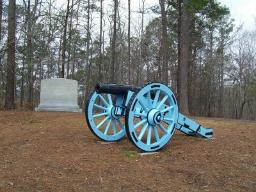
Gun Hill at Horseshoe Bend Battlefield
McCulloch's father fought at the Alabama battle.
Fought on March 27, 1814, the Battle of Horseshoe Bend was a bloody defeat for the followers of the Red Stick movement within the Creek Nation. Led by Jackson in person, a U.S. Army stormed Red Stick fortifications at the town of Tohopeka. Most of the warriors fought to the death, prompting one eyewitness to observe that the Tallapoosa River "ran red with blood." More than 800 Creek warriors died, while Jackson's force suffered losses of 49 killed and 154 wounded.

In addition to Alexander McCulloch, noteworthy individuals on the field included Sam Houston, Sequoyah, Menawa, Major Ridge, William McIntosh and others. The famed frontiersman Davy Crockett once claimed to have been there, but was not. (Note: Crockett did fight in other battles of the Creek War).

Leetown Area of Pea Ridge Battlefield
McCulloch fell while leading the Confederate attack at Leetown.
On March 13, 1862, the New Orleans Times-Picayune memorialized General Ben McCulloch in a column that reminded readers of his father as well:

Ben McCulloch, whose loss on the field of battle will be mourned by his countrymen, was the son of Alexander McCulloch, who was a lieutenant and aid to Gen. Coffee, of Tennessee, in the battles of Talladega and Horse Shoe Bend, and who resigned his commission in March, 1814.
Ben was born in Rutherford county, Tenn., in 1814. He was a captain of Texas Rangers in the Mexican war, and was distinguished for courage and conduct in the battle of Monterey. On the 11th of July, 1846, he was appointed quartermaster, with the rank of major. He was also distinguished in the battle of Buena Vista, and as the commander of a spy company, before that battle, for a most daring and successful reconnoisance. He resigned his staff appointment in 1847. At his death he was a brigadier general, commanding a division, and chiefly composed of Arkansas and Texas troops. The 3d Louisiana, Col. Hebert, was attached to this division.

General Ben McCulloch was first buried on the battlefield at Pea Ridge, but his body rests today at the Texas State Cemetery in Austin.
To learn more about the Battle of Horseshoe Bend, please visit www.exploresouthernhistory.com/AlabamaHSB.
To learn more about the Battle of Pea Ridge,  please visit www.exploresouthernhistory.com/pearidgeindex.

Wednesday, January 28, 2009

Arkansas Troops at Spanish Fort, Alabama


This is what remains of Battery McDermett (also called Fort McDermott) at Spanish Fort, Alabama. A powerful earthwork overlooking Mobile Bay, the battery was part of an impressive line of fortifications constructed by the Confederates to defend one of the key water approaches to the city of Mobile. It was occupied in the spring of 1865 by troops from Arkansas, Louisiana and Georgia.

One of the final major battles of the Civil War took place here in April of 1865. Union forces advanced up the eastern shore of Mobile Bay in the long awaited land campaign to capture Mobile. The first major barrier facing them was Spanish Fort.

With fewer than 2,000 effective men, Confederate Brigadier General Randall L. Gibson probably should not have been expected to put up much of a fight against the oncoming army of roughly 30,000 Federals under Major General E.R.S. Canby, but he did.

After skirmishing with the Union troops as they approached, Gibson pulled his men back within his defenses and forced the Federals to undertake a full siege of the Spanish Fort works. For eight days, Gibson held his works against overwhelming odds and under constant artillery fire. Then, on the night of April 8th, Gibson and his men slipped away via a previously prepared escape route.

The defense of Spanish Fort was one of the most remarkable events of the war and yet it has been virtually forgotten. Lee surrendered the day after the fall of the fort (although fighting would continue around Mobile Bay for days to come).

Very little remains of the battlefield at Spanish Fort today. The area of the Confederate fortifications are now covered by residential areas. This section of Battery McDermett is one of the best preserved sections of the original fortifications, but is overgrown and located in the midst of suburban houses. Interpretive panels explaining the battle, however, are located at the nearby Mobile Bay Overlook just off Interstate 10.

Wednesday, February 6, 2008

Please remember the tornado victims

Please take a few minutes today to remember the tornado victims from last night's storms. Death and destruction is spread from here in Arkansas across the Mississippi River to Tennessee, Mississippi and Alabama. According to the latest information, more than 50 people are dead, dozens are hurting and hundreds of people are without homes.

Please remember them in your prayers and do what you can to help. One of the best ways to help in any disaster is to donate to the American Red Cross. You can send donations specifically to help with this disaster by following this link: http://www.redcross.org/news/ds/profiles/disaster_profile_southerntornados.html.

Thank you and God Bless you.