Showing posts with label arkansas. Show all posts

Sunday, July 22, 2012

CSS Arkansas is Attacked at Vicksburg (Again!)

Vicksburg, Mississippi
On July 22, 1862 (150 years ago today), the Union fleet at Vicksburg made one more run at the famed Confederate ironclad, CSS Arkansas.
The Federals had been shelling the ironclad from long distance for days and, despite their reports of multiple hits, had done no real damage to the Arkansas. The railroad-iron sheathed gunboat intimidated the entire Federal fleet far more than the guns mounted on the bluffs of Vicksburg ever had or ever would.

They made one more attempt to destroy the Confederate warship on the morning of July 22, 1862, but things did not go well.


USS Essex (Civil War Photo)
Even though many of the men assigned to the Arkansas were ashore and there were only enough on board to man three guns, the ironclad made a formidable foe. The USS Essex, Queen of the West and General Sumter came in at full speed, planning to ram the Confederate vessel and send it to the bottom of the Mississippi River.

USS Queen of the West
(Civil War Water Color)

The Arkansas dodged the Essex, which missed its target and ran aground under heavy fire from the Confederate batteries at Vicksburg. The Union ironclad did succeed in sending a shot through the armor of the Arkansas at close range, killing 6 Confederates and wounding 6 others. Having lost 1 killed and 3 wounded, the Essex worked its way out of the mud and steamed downstream and away from the battle.

CSS Arkansas
The Queen of the West then came on, but missed as well. Turning around and coming back upstream, she succeeded in hitting the Arkansas but did little real damage. Pounded by cannon fire from both the Arkansas and the shore batteries, the Queen limped away back upstream.

The battle only succeeded to prove to Admiral David G. Farragut and other Union commanders that they would not be able to take Vicksburg using naval power alone. The CSS Arkansas, like the people of her namesake state, had proved herself to be strong, courageous and resilient. She had turned the tide of the first Battle of Vicksburg.

Farragut's attempt to end the city would end two days later.

To learn more about historic Vicksburg, please visit www.exploresouthernhistory.com/vicksburg1.


Monday, July 16, 2012

CSS Arkansas Defies the Union Fleet on the Mississippi River

CSS Arkansas as drawn in 1904 by R.G. Skerrett
150 years ago this week, the CSS Arkansas touched off one of the most dramatic naval battles of the War Between the States.

Vicksburg, then commanded by Major General Earl Van Dorn, was under attack from a massive river fleet. Admiral David G. Farragut had brought his large ships up the Mississippi after taking New Orleans and Baton Rouge. A U.S. Army flotilla of gunboats and ironclads had come down the river and the two forces were threatening Vicksburg.

Confederate Battery at Vicksburg, Mississippi
General Van Dorn, who proved himself a much more capable commander on the defensive at Vicksburg than he had on the offense at Pea Ridge in Arkansas, ordered the Arkansas from her construction port in the  Yazoo down to assist in the defense of the city. With a makeshift but courageous crew, Captain Isaac N. Brown brought the makeshift ironclad up to full steam and headed for the Mississippi.

A steam leak dampened gunpowder in the forward magazine and caused a delay, but the Arkansas was approaching Vicksburg by the morning of July 15, 1862 (150 years ago yesterday). She quickly came under attack from the U.S. gunboats Carondelet (ironclad), Tyler (wooden) and Queen of the West (ram). Most of the men making up the gun crews on the Arkansas had never handled cannon the size of those on board the ironclad, but they quickly fired a shot that disabled the Carondelet.

Wartime Image of CSS Arkansas at Vicksburg
The approach of the Confederate ironclad caught the Union fleet napping. Most of the ships did not have their steam up and Captain Brown took his vessel close by them, exchanging fire as he passed. Despite fierce cannon fire, he soon tied up at Vicksburg.

Farragut was not content to have had his entire fleet shown up by a single Confederate ship, so he prepared to exact his revenge that night. The same Chicago reporter witnessed the attack:

...Commodore Farragut made an ineffectual attempt to sink her. His entire fleet passed down the river, each vessel pouring a broadside into the Arkansas as she passed her. The Rebels acknowledge that one 7-inch steel pointed shot went through the Arkansas, but assert that this is the only damage she sustained. A reconnoissance next morning showed that the Arkansas was undergoing repairs, but she did not appear in any danger of sinking.


Old Courthouse at Vicksburg, Mississippi
General Van Dorn described the attack in a telegram dispatched from Vicksburg to the Confederate War Department in Richmond 150 years ago today:

...Enemy opened all their guns and mortars last evening, and shelled the city and batteries until after dark, when eight of their vessels of war passed down under fire of batteries and Arkansas' broadsides. What damage was done to them I have not learned, though they were repeatedly pierced by shot of the heaviest calibre. One heavy shot passed through the side of the Arkansas, killing two men and wounding three. This was all the damage done to us, with the exception of one house burned down in the city. Our troops here have a contempt for the fleet and bombardment, and await cooling for troops to land. The Arkansas is the admiration of all, and her daring and heroic act has inspired all with the greatest enthusiasm....


Total losses suffered aboard the Arkansas during her daring passage and the subsequent Union attack were 12 killed and 18 wounded, including the casualties mentioned by General Van Dorn. The Union fleet lost 23 killed, 59 wounded and 10 missing (lost in the river). The Confederate general's report was accurate, the Southern ironclad had been pierced only once despite the massive number of Union guns that fired on her.

I will continue the story of the CSS Arkansas over coming weeks, so be sure to check back for more. You can learn more about historic Vicksburg by visiting www.exploresouthernhistory.com/vicksburg1.


Friday, April 20, 2012

Crawford County Courthouse - A Civil War Landmark in Van Buren, Arkansas

Crawford County Courthouse
One of the most beautiful old structures in the Arkansas River Valley, the historic Crawford County Courthouse is believed to be the oldest courthouse in active use west of the Mississippi River.

The original portion of the building was completed in 1842 and was just seven years old when Van Buren and neighboring Fort Smith became major jumping off points for "Forty-Niners" heading west during the California Gold Rush of 1849. During the early months of that year the population of Van Buren almost doubled when an estimated 1,000 prospective miners showed up in Van Buren ready to start their journey across the Great Plains and Rocky Mountains to California.

The land on which the Crawford County Courthouse stands was donated by John Drennan and David Thompson. The two town founders had purchased the site for Van Buren from Thomas Phillips for $11,000 and the town itself was surveyed in 1837. The community actually existed to some degree before then. People had been living in and around what became Van Buren since 1819.

Historical Marker at Crawford County Courthouse
One of the most noted cases considered in the courthouse took place in 1857 when Apostle Parley Parker Pratt, a leader in the Church of Jesus Christ of Latter Day-Saints (Mormon) appeared there after being arrested in the Cherokee Nation of what is now Oklahoma. A member of the Council of the Twelve Apostles of his church, Pratt was accused of various charges related to his marriage to Eleanor McLean. One of his twelve wives, Eleanor had not divorced her previous husband. Pratt was released after being held in Van Buren for five days, but a lynch mob caught up with him at the Wynn farm near Alma and brutally murdered him. (Please click here to learn more about the Murder of Parley P. Pratt).

Crawford County Courthouse
The courthouse was 20 years old when Union troops attacked Van Buren on December 28, 1862. The Confederate army of General Thomas Hindman had marched north from the town earlier that month in a campaign across the Boston Mountains that culminated at the Battle of Prairie Grove. Unable to defeat the Federal army of Generals James G. Blount and Francis J. Herron, Hindman had fallen back across the mountains to Van Buren. When the Union army had recovered sufficiently from the massive battle in Northwest Arkansas, it pursued the Confederates south to the Arkansas River.

One-Room School of Albert Pike is on the Courthouse grounds
On December 28th the Federals emerged from the mountains at Dripping Springs in northern Crawford County. After a sharp skirmish there, they pursued retreating Confederates south into Van Buren. A running battle took place right through the center of town down the street directly in front of the historic courthouse. (Please click here to learn more about the Battle of Van Buren.)

Confederate forces across the river shelled Van Buren that afternoon, but the Crawford County Courthouse survived the battle. Thousands of pages of the county's records, however, were destroyed during the brief Union occupation.

A fire attributed to arsonists gutted the historic courthouse in 1877, sparking a fight between Van Buren and nearby Alma over which should be the county seat. Van Buren won and the courthouse was rebuilt within its still standing walls. It continues to serve the residents of Crawford County to this day.

To learn more about historic Van Buren, please visit www.exploresouthernhistory.com/vanburen.

Friday, January 6, 2012

January 7, 1862 - An Early Account of Arkansas Feds

Boston Mountains of Arkansas
The story of the Arkansas or "Mountain Feds" is an important part of the Civil War history of Arkansas.

These men and their families opposed secession and took up arms to support the Union in increasing numbers throughout the war. Many enlisted in regular Federal regiments, while others fought on their own, forming guerrilla bands that came down from the mountains to raid and create havoc.

The following account appeared in the San Francisco Bulletin on January 7, 1862, 150 years ago today:

Col. John S. Phelps
Phelps' Regiment, Missouri Infantry
The State of Arkansas is not as far gone in Secession as has been supposed. The papers say there are 1,700 secretly organized, armed and equipped Union menin the state. A few days ago, a member of her Legislature and 40 citizens made their appearance at Rollo. The member and 35 of his companions immediately enlisted in Col. John S. Phelps' Missouri Regiment, which is in camp at that palce. They brought with them a pamphlet copy of Gov. Hector's message, which was forwarded to Gen. Halleck, at headquarters in this city [i.e. St. Louis]. The Governor says there is more treason to the South lurking in Arkansas than one can well conceive, gives the people a lambasting for their want of zeal and patriotism, and charges that many of the newspapers covertly favor Union and reconstruction. The whole number of Arkansians in the military service, of the oligarchy, is 16,800; and about 6,000 more are enlisted, but are not yet furnished with equipments and arms. The State has expended over $1,000,000 for war purposes since the war began. The State war bonds have sadly depreciated, and the financial condition of the State is admitted by the Governor to be gloomy indeed. He also complains that the Generals commanding the State forces are refractory and are often at cross purposes to himself and the Military Board.

The report was filed by the Bulletin's correspondent in St. Louis, Missouri, on December 10, 1861.

January 6, 1862 - An Arkansas Man's Pistol

I found this unique little item while doing some research today and thought you might find it of interest.

It was published in the Little Rock True Democrat and picked up by the Charleston Courier in South Carolina on January 6, 1862, 150 years ago today:

We have been shown a splendid six shooter, manufactered in toto by Mr. H.H. Carter, of Arkadelphia, Arkansas, which will send a shot to the distance of a quarter of a mile. It is an excellent pistol an the finish compares favorably with any work of the kind we ever saw.

Such innovation by individual inventors was quite common during the Civil War, with private inventors developing everything from pistols to submarines. All across the South, especially, people tinkered with ideas they thought would help the men at the front. Many developed small factories of their own, turning out weapons and other equipment for the Confederate armies.

If any of you know more about Mr. Carter and his pistol, I would love to hear from you! I would love to see a photo of one of his revolvers.

Tuesday, July 12, 2011

The Arkansas Wild Man - A Pre-Civil War Bigfoot in the Natural State

Mountains of Arkansas
One of my favorite Arkansas stories from newspapers dating before the Civil War is the tale of the famed Wild Man of the Woods, clearly a 19th century manifestation of the creature that most today know as Bigfoot or Sasquatch.

Reports in the Memphis Enquirer indicate the creature was first reported in eastern Arkansas as early as 1834. The first detailed account, however, was published in 1846 and repeated in newspapers across the nation. It told of sightings of the creature near Crowley's Ridge west of Memphis. The "wild man" was said to be of gigantic stature, covered in hair, and eyewitnesses said that "his track measures 22 inches, his toes are as long as a common man's fingers, and in height and make, he is double the usual size."

This was one of the first detailed accounts of the discovery of Bigfoot tracks in American history and came long before the first recorded sightings in the Pacific Northwest.

Swamp in Eastern Arkansas
Over the decades that followed, the Wild Man seems to have made regular appearances about every five years. He was seen chasing a herd of cattle in 1851 and Colonel David C. Cross of Memphis organized an expedition to capture him. The effort failed, but it seems to have been the first recorded Bigfoot hunt in American history.

Reports of the creature appeared again in 1856, this time in southern Arkansas and up into the Ouachita Mountains. A fairly bizarre report even told of a vicious attack on a man who was part of a group trying to capture the monster.

Bigfoot reports continue in Arkansas to this day, but the 19th century written accounts hold a unique place in the history of the United States.

To learn more about the real history of the Arkansas Wild Man, please visit www.exploresouthernhistory.com/arwildman.

Tuesday, June 21, 2011

The Battle of Jenkins' Ferry, Arkansas - Capt. John Whiteford's letter to his wife

Jenkins' Ferry State Park
The letters of Captain John Whiteford, a Southern Unionist who commanded Company I, 1st Arkansas Infantry (U.S.) during the Camden Expedition of the Red River Campaign, reveal a great deal about the tribulations of a Southern family that fled north during the Civil War.

Whiteford was a resident of Texas when that state left the Union in 1861. Leaving his wife "among strangers" at Fort Riley in Kansas, he enlisted in the Union army. In September of 1863, he was appointed as the captain of Company I, 1st Arkansas (U.S.). In this capacity he served first in Sebastian County, but went on to fight in the Camden Expedition.

Saline River at Jenkins' Ferry Battlefield
On April 30, 1864, Whiteford was among the Union officers and soldiers who threw back the bloody attacks of Confederate forces at the Battle of Jenkins' Ferry on the Saline River near Sheridan, Arkansas. Under the command of General Kirby Smith, Southern troops tried to destroy the retreating Union army as it crossed the flooded Saline River at Jenkins Ferry. The attacks, however, were not well coordinated and the Federals escaped after inflicting heavy casualties on the Confederates.

Whiteford, who had never actually been mustered into the service and would later be labeled a "civilian" by the Union army, led his company in heavy fighting at Jenkins' Ferry and described the scene in a letter to his wife a short time later:

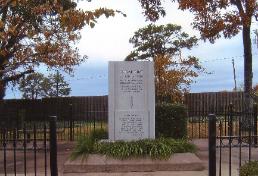
Jenkins' Ferry Battle Monument
...The infantry were in the rear to protect the train, and fight the rebels, while the balance of the army were crossing on the pontoon. It was a regular infantry fight. The rebels had four pieces of artillery in making the attack on us, but the Second Kansas Colored Volunteers captured that after the third charge, and then we had an even show. They massed their infantry on us and charged fiercely, but it was no go. Our regiment (Second Arkansas) distinguished itself. The dead rebels were thick over the ground. As we drove them back one man, by my side, was shot, and the bushes and sapplings were cutting down in front of me and bark and dirt thrown in my face, but no ball touched me. Thanks to God, who saw fit to spare my life awhile longer. The musketry was fiercer and more constant than at Prairie Grove. We fought all day on swampy land. The night before we were up all night in the rain in line of battle, and during the fight we were up to our knees in water, and when we had drove the enemy back we had to march on return four miles through mud knee deep. - Capt. John Whiteford, May 4, 1864.

Whiteford continued by describing the actual crossing of the Saline River, which took place at the site of today's Jenkins' Ferry State Park:


...Union families from Camden had to leave their carriages in the mud, and carry their children to the bridge. Men even dropped down in the confusion and wagons pass over them, it raining all the time. When we got across the bridge we had three miles more of such mud. Such a sight of women and children crying, and horses and mules dying, and wagons abandoned, I never saw. The rebels came to the river after we had crossed, but too late to do us any damage. We had destroyed the bridge that night, and all the wagons except one to each brigade. - Capt. John Whiteford, May 4, 1864.

Although the numbers may not be accurate, reported losses at the Battle of Jenkins' Ferry were 86 killed and 356 wounded for the Confederates and 63 killed, 413 wounded and 45 missing for the Federals.

You can learn more about the battle and today's Jenkins' Ferry State Park at www.exploresouthernhistory.com/jenkinsferry1.

Wednesday, June 15, 2011

Fort Smith NHS to host programs on Native Trees

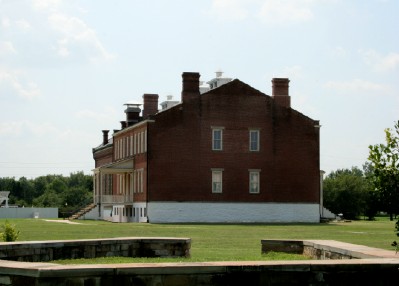
Fort Smith National Historic Site
There is a neat educational program coming up on Saturday (June 18) at Fort Smith National Historic Site in Fort Smith that offers a great opportunity to learn about the original trees that grew in the area and how they were used by soldiers at Fort Smith decades before the Civil War.

Here are the details from the National Park Service:

Native Trees of Fort Smith
Trail of Tears Overlook at Fort Smith NHS
Saturday, June 18, 2011 at 10:00 a.m. and 1:00 p.m., Fort Smith National Historic Site will present a program on the importance of trees to Native Americans, soldiers, and early settlers. To survive on the frontier, a good knowledge of how to use various trees was necessary. Program participants will learn about five trees used by the first soldiers at Fort Smith and how they were used in building the fort.

Fort Smith National Historic Site is located in downtown Fort Smith . To access the free parking lot from Garrison Avenue, turn south on 4th Street and west on Garland Avenue . For more information, please call the park at 479-783-3961.

Fort Smith National Historic Site preserves the remains of two important frontier forts that served the United States from 1819 through the end of the Civil War. The post was subsequently used as a base of operations for U.S. District Judge Isaac C. Parker, the "hanging judge" of the Old West, and his force of deputy U.S. marshals that brought law and order to the frontier during the turbulent years after the Civil War.

To learn more, please visit www.exploresouthernhistory.com/fortsmith.

Friday, April 22, 2011

"The Battle of Massard Prairie" now available as a Kindle instant download

My 2008 book, The Battle of Massard Prairie: The 1864 Confederate Attacks on Fort Smith, Arkansas, is now available as an instant download for the Amazon Kindle reading device or Amazon's free Kindle software for your computer or smart phone. The instant download is priced at only $4.95.

Fought on July 27, 1864, the Battle of Massard Prairie was the largest Civil War action in the immediate Fort Smith area and resulted in the virtual annihilation of a battalion of the 6th Kansas Cavalry in a devastating open field attack by a Confederate cavalry force.

The battle developed when Confederate General Douglas Cooper learned that a battalion of the Union 6th Kansas was camped in the "Diamond" or "Picnic" grove on Massard Prairie, outside the fortifications that surrounded the City of Fort Smith. He sent General Richard Gano and a large mounted force to attack the Federals, hoping to draw them back into an ambush at the Devil's Backbone ridge south of Fort Smith.

When Gano's cavalry force assembled just across the line in what is now Oklahoma, however, he realized that he had fewer men than expected. He took the initiative and altered his plan of attack, deciding instead to sweep down on the unsuspecting Union soldiers from three directions at daybreak on the morning of July 27, 1864,

The attack was a brilliant success. The Union line of battle crumbled almost as soon as it was formed and Gano's force of Texas, Choctaw and Chickasaw cavalry chased the Federals for more than one mile across the open prairie. By the time the smoke had cleared, the 6th Kansas Cavalry had lost 144 of the roughly 200 men camped on Massard Prairie. The Confederates lost 34 men in the battle.

In addition, Gano's men captured 200 Sharps rifles, 400 six-shooters, horses, supplies, camp equipment and more. The action was described in military reports of the time as "a right gallant little affair."

The Kindle download can be ordered by clicking the ad at the upper left. You can also learn morea bout the Battle of Massard Prairie by visiting www.exploresouthernhistory.com/massardindex.

Saturday, February 5, 2011

Rumors of War in Fort Smith, February 6, 1861

19th Century map of Indian Territory
Although Arkansas voters had not yet made their decision to convene a Secession Convention, the state like much of the South was caught in an outbreak of war fever.

News reached Fort Smith on the state's far western border 150 years ago tomorrow of a plan by troops from Texas, which had already seceded, to move on the U.S. Army posts in the Indian Territory of today's Oklahoma. The forts were important points of supply and defense that would critical in the war that everyone new was coming. The Choctaw, Chickasaw, Creek, Seminole and Cherokee Nations created a buffer zone between the Southern state of Texas and the Northern state of Kansas. Their control would likely lead to control of the Indian Territory as well.

The following account from Fort Smith appeared on the front page of the New York Herald on February 7, 1861:

IMPORTANT FROM THE INDIAN TERRITORY.

Threatened Attack on Forts Washita, Cobb and Arbuckle – The Little Rock, Ark., Arsenal Seized.

Fort Smith, Ar., Feb. 6, 1861.

Advices received today by the editor of the Thirty Fifth Parallel state that the Texans have threatened to take possession of Forts Washita, Cobb and Arbuckle, in the Indian Territory.

It is thought that the force at each of these stations is sufficient to protect them.

The conductor of the overland mail from Little Rock, Ark., reports that the arsenal there was taken possession of by State troops on Saturday evening last.

The rumors about Forts Washita, Cobb and Arbuckle was accurate, although no expedition for that purpose was yet underway.
To read about historic sites in Oklahoma, please visit www.exploresouthernhistory.com/oklahoma1.

Wednesday, February 2, 2011

Traveler from Fort Smith describes "Trophy" of the Mountain Meadows Massacre

19th Century Engraving of the Mountain Meadows Massacre
As late as February of 1861, the frontiers remained stunned by the Mountain Meadows Massacre, a bloody slaughter that took place when Mormon militia and Indian allies attacked a wagon train making its way from Arkansas to California near present-day St. George, Utah.

The attack on members of the Fancher-Baker party came on September 11, 1857, as they were driving a herd of hundreds of cattle west to California where beef was desperately needed in the golf fields. Noted Mormon or L.D.S. missionary Parley Pratt had recently been killed in Arkansas and the tension between the Mormon emigrants who had settled in Utah and the United States was growing. For reasons that continue to be debated today, militia members and their Indian allies attacked the wagon train, took the cattle and other supplies, and killed an estimated 120 or more members of the party. Only 18 small children were spared to be adopted into local Mormon families. They were subsequently taken into the custody of the U.S. government and returned to their families in Arkansas.

Arkansas Grave of Parley Parker Pratt
In February of 1861, a traveler from Fort Smith reached Stockton, California, with the gruesome story of having seen a riata or lasso made from the hair of the victims of the massacre:

A RIATA MADE OF WOMAN’S HAIR. – The Stockton (California) Republican learns that Mr. Connolly, who has just returned from Fort Smith, Arkansas, via Salt Lake, reports having seen a Texan purchase a riata one hundred feet in length of an Indian, for which he paid $20. The hair from which it was made was shorn from the heads of the women who were slain at the ever-to-be-rememebred massacre of the Mountain Meadows. The gentleman states that the riata was one of the most beautiful ever beheld, even while the scene of cold-blooded slaughter rose to his view as he looked upon this trophy of the savages and their Mormon allies, worse than savages. - Various Newspapers, February 1861.
Only one person was ever punished by man for his role in the massacre. John D. Lee, a leader in the Mormon militia at Mountain Meadows, was executed after the Civil War after being convicted of murder.


Beaver Bridge in Arkansas
There are several places in Arkansas where more can be learned about the events leading to the massacre. A monument to the victims stands in Harrison in northern Arkansas, where many of the members of the ill-fated party had lived prior to joining the wagon train. At Beaver near Eureka Springs, although few visitors realize it, the picturesque Beaver Bridge - often called the "Golden Gate of Arkansas" - spans the White River at the point where members of the Fancher-Baker party waded across during the early stages of their journey west. Learn more about the beautiful bridge and early history of the crossing at www.exploresouthernhistory.com/beaverbridge.

Also of interest is the monument near Alma and Van Buren marking the grave of slain LDS leader Parley Pratt, who was killed in Crawford County in May of 1857 (the same year as the massacre) by a part of vigilantes headed by the irate first husband by one of his plural wives. You can read more about the murder and monument by visiting www.exploresouthernhistory.com/parleypratt.

Saturday, January 22, 2011

February 1861 - A Gunfight in Fort Smith

Garrison Avenue in Fort Smith
As citizens from across Arkansas debated whether the state would join her Southern sisters in seceding from the Union, a violent situation of a different sort broke out in Fort Smith.

There was an old saying that there was "no law west of St. Louis and no God west of Fort Smith," and the events that took place there in February of 1861 gave some real meaning to the quote. A gunfight broke out in a local grocery and citizens swarmed into the streets with vengeance on their minds. The situation was so bad that soldiers from the post of Fort Smith had to intervene and even then they were not able to save the lives of all of the suspects involved:

Fort Smith National historic Site
A terrible tragedy occurred at Fort Smith, Arkansas, Thursday night. A party of five overland mail and Little Rock coach drivers entered the grocery of a German, named Hagge, and commenced quarreling; pistols were drawn on both sides; the barkeeper, named Butcher, was shot through the heart and died instantly; Hagge received a shot in the forehead and died at eight o’clock Friday morning. Three of the drivers, George Bennett, Matt Ellis and Pony Farmer, were arrested, and guarded by a company of military. The other two escaped. Intense excitement was created; a mob entered the justice’s office for the purpose of lynching them. – Farmer, one of the prisoners, broke from custody and attempted to escape. He was fired upon and instantly killed. The crowd then secured the remaining prisoners and made for a place of execution, but before they could carry out their designs the authorities interfered and secured the prisoners, and lodged them in Greenwood jail. The excitement in regard to the affair still continues intense. - Pittsfield Sun, February 28, 1861.

Accounts of the outbreak were carried in newspapers across both the Union and Confederacy, interrupting temporarily the drums of war being beaten by newspaper editors North and South.

You can read more about the history of Fort Smith at www.exploresouthernhistory.com/ARFortSmith1.

Saturday, January 15, 2011

Southern Eyewitness of Prairie Grove - Part Two

Prairie Grove Battlefield
Note: This is part two of a Southern eyewitness account of the Battle of Prairie Grove. Please click here to read part one.

We had approached within 80 yards, when the Yanks wavered and fled in every direction. Their wounded and dead lay everywhere, the wounded crying for mercy. The villains! Their own black deeds of murder, in their death agonies, came (flooding?) back to memory in his bloody (mind?), and they expected justice to be given them by the outraged friends of their murdered victims. But the Southern soldier is as merciful as he is brave, and the vandals’ cry for protection was a useless one; a fallen foe is an object of pity – they were well cared for by our gallant lads.

Route of Hindman's Retreat
By nightfall we had driven them some two miles, captured  618 wagons, heavily laden with clothing, some (illegible) head of horses, and 280 prisoners. But our men were exhausted by hard marches and hunger, having had nothing scarcely to eat for three days – Gen. Hindman had not calculated to fight so large a force. It was his aim to  capture Blount, before the latter’s reinforcements arrived, and then pay his respects to the reinforcing column. The plan was an excellent one, and would have succeeded, but for the fact that as soon as we commenced to cross the river, a swift-winged Arkansas traitor carried the news to Blount, he to the column reliving him, and by hurried marches they arrived as soon as we. Therefore, we their grand army, and the sun of the 7th inst. closed on our victorious arms. The Feds that night at 10 o’clock sent a flag, asking for an armistice of 23 hours to bury their dead, &c. Gen. Hindman gave them 12 hours. About dark they were reinforced by an Iowa brigade.

We were three days out on forced marchies, no supplies at hand, the men worn out by hunger, and too much exhausted to hazard a renewal of the conflict, until rested, with the superior force against us, we withdrew from the field at 11 o’clock that night in silence, to a point some 12 miles distant, where we remained thirty hours. If we had only received a few thousand reinforcements, the Federal invading army now in the NorthWest would have been annihilated. But they did not come to us, and our brave and excellent Gen. Hindman could only give them a severe check and then retire – they powerless to follow, and we unable to renew the conflict.

Our loss in the battle is about 1,000 in killed, wounded and missing; the Feds say their loss is 1,300.

To learn more about the Battle of Prairie Grove, please visit www.exploresouthernhistory.com/ArkansasPG1.