Showing posts with label fort smith. Show all posts

Friday, July 27, 2012

Battle of Massard Prairie (148th Anniversary)

Massard Prairie Battlefield Park
Fort Smith, Arkansas
Today marked the 148th anniversary of the Battle of Massard Prairie, Arkansas.

Fought on July 27, 1864, the engagement was a significant cavalry action fought across miles of prairie on the outskirts of Fort Smith. It was a major Confederate victory and resulted in the virtual destruction of Mefford's Battalion of the 6th Kansas Cavalry.

The battle began when Brigadier General R.M. Gano's Confederates swept down the ridge from today's Fianna Hills community on the southern edge of Fort Smith and caught the Federal forces camped at the Picnic or "Diamond" Grove on Massard Prairie completely by surprise. The Union troops had just moved their herd of horses out onto the prairie to graze when the Confederates struck:

...As soon as the alarm was given that the enemy was in the prairie, which was about 6 a.m., I sent immediately for the herd, which had been out grazing since daylight, and was about three quarters of a mile southwest of camp. I formed my men on the right of camp to protect my herd as it came in and until it could be secured, but before the horses could be brought up the enemy charged on us, which stampeded the herd and left the men on foot to fight as best as they could. - Lt. Jacob Morehead, 6th Kansas Cavalry.

Gen. R.M Gano, CSA
Sweeping around the Union right to the sound of the Rebel yells of his Texans, Gano had stampeded the Federal herd and closed in on the Federal camp before Major David Mefford could get his men organized to save the horses and resist. As he approached the grove, Gano detached part of his column to drive right into the center of the trees as he struck the camp on its western flank.

At the same time, Colonel S.N. Folsom led the 1st and 2nd Choctaw Cavalries (C.S.) in a devastating attack on the Union left. These were the same men who exacted had such fierce revenge on black Union troops at the Battle of Poison Spring for attrocities in the Choctaw and Chickasaw Nations that they were later accused of massacre.
Charged on right, left and center, the Federal lines collapsed and blue-clad cavalrymen began a desperate attempt to escape to safety across the prairie. By the time the fighting ended, three companies of "Arkansas Feds" (Union soldiers from Arkansas) had evaporated so completely they were not even mentioned in Union reports of the battle. Of the roughly 200 men (four companies) of the 6th Kansas Cavalry engaged in the battle, 144 were killed, wounded or captured.

To read about the Battle of Massard Prairie, please visit www.exploresouthernhistory.com/ArkansasCW4. Also please consider my book, The Battle of Massard Prairie. It is available in both book and Kindle editions by following these links:

Book - The Battle of Massard Prairie ($14.95)
Kindle - The Battle of Massard Prairie, Arkansas ($4.95)

Monday, February 6, 2012

Pea Ridge #3 - A Cold Winter on the Ozark Plateau

Elkhorn Tavern in the Snow
National Park Service
This is part three of a six week long series commemorating the 150th anniversary of the Battle of Pea Ridge, Arkansas. To read the two previous posts, click Pea Ridge #1 and Pea Ridge #2.
The winter of 1861-1862 was remarkably cold in the Ozarks region of northern Arkansas, even though it was strangely warm deeper in the Deep South.

From Alabama and Mississippi, for example, there were reports that meat was spoiling because there had been no proper "hog killing weather." In Arkansas, however, the snows were piling up. Letters written home to Louisiana by soldiers serving under Colonel Louis Hebert, for example, described snow accumulating to depths of between one and two feet in Benton County.

Ice Storm at Pea Ridge Battlefield
National park Service
The men serving in Northwest Arkansas that winter, however, were reasonably well-housed and well-equipped. Winter quarters in the Cross Hollows area between Fayetteville and Bentonville were strongly constructed of sawed lumber and the thousands of men camped there were sheltered from the cold wind, sleet and snow the characterized that winter. Most described their cabins as "comfortable."

They also were as well-fed as any army in the field at that time. The Arkansas River had been running high through the winter, allowing steamboat traffic to continue at a brisk pace between Little Rock and Fort Smith. The latter city was a major supply center for Confederate troops serving in the West and a steady stream of supply wagons made its way up and over the Boston Mountains with provisions, clothing, shoes, weapons and other necessities for the troops in Washington and Benton Counties.

Gen. Earl Van Dorn, CSA
Sickness was also diminishing in the camps. Most of the men had now served long enough for their systems to adapt to the rigors and stresses of service in the field.

Meanwhile, elsewhere in Arkansas, General Earl Van Dorn had arrived in Pocahontas and appeals had been issued for the men of Arkansas to enlist in his army as quickly as possible. In every county of the state, new companies were forming and preparing to march in response to the calls of General Van Dorn and Governor Rector. An army was forming of sufficient size to approach the Union onslaught that was expected to come down from Missouri in the spring.

I will continue posting on the 150th anniversary of the Battle of Pea Ridge over coming days and weeks, so please check back often. You can read more about the battle anytime at www.exploresouthernhistory.com/pearidgeindex.

Thursday, January 19, 2012

January 1862 - Prelude to Pea Ridge

Pea Ridge National Military Park
This year marks the 150th anniversary of the Battle of Pea Ridge, Arkansas, not just one of the largest battles west of the Mississippi, but one of the most significant actions of the entire Civil War.
As part of the commemoration of this battle that preserved Missouri for the Union, I will be posting throughout January, February and March on the Pea Ridge campaign, using as often as possible the words of the soldiers, generals and civilians that witnessed it. Be sure to check back regularly for the latest posts.

Curtis
To try to set the stage as well as I can, the Pea Ridge Campaign began to develop in January of 1862 as two armies began to assemble for battle. The Union army, commanded by Gen. Samuel Curtis, was centered at Rolla, Missouri, a town about 112 miles northeast of Springfield. Curtis was determined to drive Confederate forces, particularly the Missouri State Guard under Gen. Sterling Price, from Missouri and fully establish control over the state, which was very divided in its loyalties.

The Confederates, in turn, were equally determined not only to hold at least part of Missouri if possible, but to stop Curtis from advancing into Arkansas. In mid-January of 1862, however, their forces were scattered and had yet to assemble for battle. The Missouri State Guard, under Price, was clinging to its position at Springfield, Missouri. Gen. Price knew, however, that he could not hold there against Curtis's much larger army.

Price
The Missouri general for more than one month had been begging for help from Arkansas. A force of 3,000-4,000 Confederates were centered around Fayetteville in Northwest Arkansas under Gen. Ben McCulloch. Unfortunately, Price and McCulloch did not get along. Not only would the latter general not reinforce Price, he had gone to Richmond to discuss the situation with officials there, leaving Col. Louis Hebert of Louisiana in command. Hebert promised Price that he would reinforce him in an emergency and did his best to get supplies through to the State Guard, but otherwise maintained his force in its winter quarters around Fayetteville.

To the south in the Arkansas River valley, Gen. James McIntosh commanded a large cavalry force that was wintering around Van Burn and Fort Smith. He had declined a request from Price for help in December and gone instead to support Col. D.H. Cooper in the Cherokee Nation where he had won the Battle of Chustenahlah several weeks earlier.

Van Dorn
To try to end the confusion and bickering in the West, President Jefferson Davis appointed Major General Earl Van Dorn as head of what he would style the "Army of the West." Van Dorn was not yet on the scene in mid-January, but was heading that way. He was not thinking of just halting Curtis, he had dreams of a major offensive campaign. He told his wife on the day of his appointment that he "must have St. Louis."

To Van Dorn would fall the task of pulling together the three major Confederate forces then assembled in Missouri and Arkansas and leading them into battle. He would receive support from Gen. Albert Pike's brigade of Southern-allied Indian troops.

I will continue to post on the Pea Ridge Campaign throughout the coming weeks. To read more about the battle itself, please visit www.exploresouthernhistory.com/pearidgeindex.

Friday, January 6, 2012

January 8, 1862 - A regiment of Fort Smith apple peddlers?

Casper Reutzel House (1850)
Fort Smith, Arkansas
The following report appeared in the Dallas Weekly Herald in Dallas, Texas, on January 8, 1862, 150 years ago today.
While its primary purpose was to tweak Arkansans a little about the supposed slowness of men around Fort Smith to enlist in the Confederate army, it is also an interesting reference to the Civil War era apple industry:

John Rogers House (1840s)
Fort Smith, Arkansas
We hear a great deal said about the indifference manifested by Arkansians, around Fort Smith, in the little matter of enlisting in the service of the Confederate States. Fort Smith has long been a favored locality and we fear that the "lust of lucre" has spoiled the people and made them look to much to other people for the protection of their homes and property. If the Northern counties of Arkansas would recall a few hundred of their valiant sons engaged in peddling apples in Texas her ranks in the Confederate army would be considerably swelled and perhaps be rendered more effective. Texans don't object to the apples, - only it don't look so very becoming to see strong, able-bodied and brave men peddling apples when there is so great a need for men in the army. A regiment of apple-peddlers would be a formidable arm of the service.

Fort Smith was, of course, a city of divided loyalties throughout the war. Many Sebastian County residents enlisted, fought and died in the Confederate service, but many others did the same in the Union army.

If you would like to learn more about the city's Civil War history, be sure to consider my book:
The Battle of Massard Prairie: The 1864 Confederate Attacks on Fort Smith, Arkansas.

It is also available for instant download for Amazon's Kindle devices or their free software for your PC, iPad, etc.

You can also read more about Fort Smith at www.exploresouthernhistory.com/ARFortSmith1.

Thursday, December 22, 2011

Massard Prairie book Free today only for Kindle Users!

The Battle of Massard Prairie, Arkansas is available FREE today only for users of Amazon's Kindle readers or free Kindle software as part of a special promotion at Amazon.com.
The book actually tells the story of two battles: The Battle of Massard Prairie and the Battle of Fort Smith. These two encounters were part of a demonstration carried out by Confederate forces in late July and early August of 1864 against the Federal forces occupying Fort Smith. They were wildly successful.

The Battle of Massard Prairie was fought on July 27, 1864, and resulted in the virtual destruction of an entire battalion of the Sixth Kansas Cavalry (U.S.). Sweeping down from the hills on the south side of the modern city of Fort Smith, Confederate cavalry forces hit the Federal camp on Massard Prairie from three sides. The Union force broke and was chased down and scattered in a cavalry battle that swept across miles of open prairie. A Confederate victory, the battle was an important prelude to the Battle of Cabin Creek in Oklahoma the following month.

The Battle of Fort Smith was fought just a few days after the action at Massard Prairie and was largely a demonstration against the southern defenses of Fort Smith. It resulted in the capture and destruction of Union supplies and the safe evacuation of pro-Confederate citizens from the environs of the city.

Together the two battles forced Union commanders at Fort Smith to draw in their forces, opening the door for the subsequent Confederate victories at Flat Rock and Cabin Creek in the Cherokee Nation. Cabin Creek may have been the largest supply seizure of the war by Southern forces.

To download the free Kindle version of the book, please click here:
The Battle of Massard Prairie, Arkansas: The 1864 Confederate Attacks on Fort Smith

If you do not have a Kindle reader, you can download the free software for your computer, tablet, iPad, smartphone, etc., at Amazon.com.

The book is also available in a print edition for $19.95.  Please click here to order:
The Battle of Massard Prairie: The 1864 Confederate Attacks on Fort Smith, Arkansas

Enjoy your free reading and Merry Christmas!

Friday, December 9, 2011

Historic Sites of the Prairie Grove Campaign

Prairie Grove Battlefield State Park
I've spent the last three weeks looking at events associated with the Battle of Prairie Grove and the Prairie Grove Campaign, which took place 149 years ago this year. I thought telling you about some of the sites of the campaign as they appear today might be a good way to wrap up the series.

I have arranged these in order beginning with Prairie Grove battlefield.


Borden Orchard at Prairie Grove Battlefield
Prairie Grove Battlefield State Park

One of America's most beautifully maintained Civil War sites, Prairie Grove Battlefield is a state and national historical treasure. Located at 506 E. Douglas Street in Prairie Grove, Arkansas, the park is only 18 minutes from downtown Fayetteville. From I-540 through Northwest Arkansas, take the Farmington exit (#62) and follow U.S. 62 West 9 miles to the battlefield.

The park preserves the scene of some of the heaviest fighting of the Battle of Prairie Grove, including the right flank of the Confederate line where Herron launched his bloody assaults, the Borden house and orchard (the house was rebuilt by the family after the war on the same foundations) and the ground across which Herron's attacks were launched. A number of historic structures are preserved at the park, which also features a museum, interpretive panels, cannon, monuments and a one-mile Battlefield Trail that loops through areas of heavy fighting. A driving tour takes visitors to other key points of the battlefield, including an overlook on the western end of the battlefield.

The park is open daily from 8 a.m. until one hour after sunset and also offers a picnic area, playground, restrooms, etc.  To learn more, please visit the park service website at: http://www.arkansasstateparks.com/prairiegrovebattlefield/.

You can read more about the battle and see photos of the battlefield at www.exploresouthernhistory.com/ArkansasPG1.


Battle of Cane Hill Historical Marker
Cane Hill Battlefield

While the Cane Hill Battlefield has not been developed as a park, efforts are currently underway to create a driving tour and install interpretive signage. The first of the panels are now up, including one at the town cemetery.

To reach Canehill (as it is spelled today) from Prairie Grove, follow U.S. 62 West for 4.8 miles then turn left (south) on AR-45 and follow it for 3.4 miles. There is a Battle of Cane Hill marker on AR-45. Be sure to see the interpretive panel at the cemetery and check out the historic Cane Hill College building on College Road one block west of AR-45. The existing building was built shortly after the Civil War, but the college was a major facility for learning when the war broke out.

Cane Hill Battlefield
The Battle of Cane Hill began just north of the college and flowed south for miles into the mountains. To view the battlefield from the highway, travel south along AR-45 for two miles to the intersection with Clyde Road. This drive takes you along the battlefield and you can view the terrain across which it was fought. The battle continued down what is now Clyde Road.

To follow the course of the fighting, follow Clyde Road for 1.4 miles to Four Corner Road. Turn left on Four Corner Road and follow it up and over Reed's Mountain (see below) for 4.4 miles to Cove Creek Road at the site of Morrow's Station (see below).  As you pass up and over the mountain, you are driving through one of the scenes of heavy fighting. Once you reach Cove Creek Road, turn right and drive until the road passes through a narrow area between the creek on your left and a rocky bluff on your right. This was the scene of the Confederate ambush that closed the fighting.

Please keep in mind that once you leaved the pavement, some of these dirt roads can be slick and difficult to travel during raining weather. Please exercise caution.

The staff at Prairie Grove Battlefield State Park can provide additional information on the Battle of Cane Hill. You can also learn more at www.exploresouthernhistory.com/ARCaneHill.


Reed's Mountain looking down to Morrow's Station
Reed's Mountain Battlefield

To reach the scene of the Reed's Mountain fight from Canehill, follow the directions given above for the Cane Hill Battlefield. The fighting took place along both sides of what is now Four Corner Road from the crest of the mountain down to the intersection with Cove Creek Road. There are no markers or other interpretation at the site. Please click here to learn more about the battle: www.exploresouthernhistory.com/ARReedsMountain.


Morrow's Station

Morrow's Station was located around the modern intersection of Four Corner Road and Cove Creek Road. It is often confused with the nearby town of Morrow, which also existed in 1862, but was actually at this site. There are no markers or other interpretation at the crossroads, but the Morrow Cemetery still exists just west of the intersection.

To reach Morrow's Station, follow the directions above for the Cane Hill Battlefield.


Cove Creek Road
Cove Creek Road

Cove Creek Road can be followed south from the Morrow's Station site into Crawford County or north from that point back to Prairie Grove. This was the main route followed by the Confederate army as it both advanced to and departed from the Battle of Prairie Grove.


Dripping Springs
Dripping Springs

To reach Dripping Springs, site of the Confederate cavalry camps, without getting lost in a myriad of small roads, I recommend that you retrace your steps from Cove Creek Road (as given above under Cane Hill Battlefield) back to the intersection of Clyde Road and AR 45. Turn left (south) on AR 45.

Follow AR 45 for 5.7 miles to the intersection with AR 59 at Dutch Mills. This community was an important landmark of the Civil War in Northwest Arkansas. Turn left on AR 59 and follow it south for 29 miles. Along the way you will pass through the stateline community of Evansville, to which Colonel Stand Watie advanced with his brigade of Confederate Cherokee during the campaign. Just south of Cedarville, look for the intersection with Uniontown Highway. A marker for the later Battle of Dripping Springs (fought later in December of 1862) can be seen just to the left of the intersection.

Turn right on Uniontown Highway and follow it roughly one mile to its intersection with Dripping Spring Road. Turn left on Dripping Spring Road and follow it for 6/10 of a mile to its intersection with Beverly Hills Drive and Old Uniontown Road. This is the site of Dripping Springs.

The Confederate cavalry camps were primarily on the hill to your left and the little spring that gives the crossroads its name is on private land to your right just beyond Old Uniontown Road. There are no markers at the site.


Confederate Section at Fairview Cemetery
Fairview Cemetery at Van Buren

To reach Fairview Cemetery at Van Buren from Dripping Springs, follow Old Uniontown Road for 4.4 miles to its intersection with AR 59.  Turn right on AR 59 and follow it for 2.7 miles until you see Fairview Cemetery on your left just after you travel down a steep hill.

In the Confederate section of Fairview Cemetery (in the northeast corner of the cemetery), you will find the graves of many of the Confederate wounded who died after the battle. Taken back to hospitals in Van Buren, they lingered in pain for weeks and months. A monument commemorates the role of these men in a series of battles including Wilson's Creek (Oak Hill), Pea Ridge, Prairie Grove, etc.

Be sure to take time to walk through other areas of the historic cemetery, where you will find the graves of many people of importance to early Arkansas history.  To learn more about Fairview Cemetery, please visit www.exploresouthernhistory.com/fairviewcemetery.html.


Main Street in Van Buren
Van Buren

From Fairview Cemetery, follow AR 59 (Fayetteville Road) south for three blocks to the train depot at Main Street.  The depot provides a great view down Main Street through the center of town.

Van Buren was the launching point for the Prairie Grove Campaign and was General Hindman's headquarters during the early stages of the campaign. It is now a charming, historic town with numerous shops, restaurants and other points of interest downtown. The historic Crawford County Courthouse a few blocks south on Main Street is of pre-Civil War construction and was a landmark of Van Buren at the time of the campaign. On its grounds can be found historical markers, monuments and the original log schoolhouse where Masonic leader and Confederate general Albert Pike once taught school. A park borders the Arkansas River at the south end of Main Street. 

Take some time and enjoy Van Buren and what this heritage minded city has to offer.  To learn more about Van Buren's history, please visit www.exploresouthernhistory.com/vanburen.


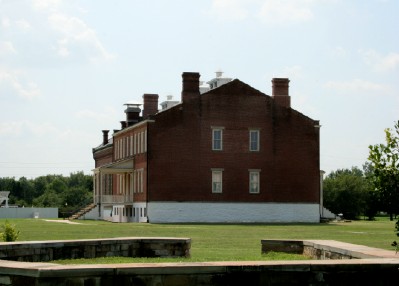
Barracks Building at Fort Smith
Fort Smith National Historic Site

Directly across the Arkansas River from Van Buren is the historic city of Fort Smith. The original
barracks and quartermaster's storehouse buildings of the fort still stand at Fort Smith National Historic Site.

The fort was used as a supply depot and command center by both Union and Confederate forces during the Civil War and its museum features an outstanding exhibit on the Civil War in and around Fort Smith.

To learn more, please visit www.exploresouthernhistory.com/fortsmith.html.


In addition to the sites I've discussed here, Fayetteville National Cemetery and Fayetteville Confederate Cemetery are definitely worth visiting. The remains of Union soldiers killed at Prairie Grove and Cane Hill are at the national cemetery, while the Confederate cemetery contains the graves of Confederate soliders killed in those fights.

Fayetteville Confederate Cemetery:  www.exploresouthernhistory.com/fayettevillecc.html

Fayetteville National Cemetery:  www.exploresouthernhistory.com/arfayettevillenc.html

And, as always, you can learn more about the Prairie Grove Campaign at www.exploresouthernhistory.com/ArkansasPG1.

Tuesday, September 20, 2011

Memories of a Fort Smith War Widow

Commissary Storehouse at Fort Smith
One of the saddest stories I have encountered in my research into the Civil War in Arkansas is that of Catherine C. Cox, who lived on the outskirts of Fort Smith.
She and the men of her family were Unionist in their sympathies and her husband, Christopher Cox, had died of natural causes shortly after the beginning of the war. His death, sadly, was just the beginning of tragedy in her life, as she explained in a later petition to the U.S. Government:

...My husband left three children, two sons and a daughter. The oldest son, Albert Cox, enlisted in the United States service in Genl. Steele's Arkansas Regiment and died have neither wife nor children. I think his regiment was the 1st Arkansas. - under command of a man named Stele. His second son was named Henry was taken away aged 15 years by the rebels and it is said he died of small pox. His daughter Mary Jane is about 22 years old, married as I understand since I left Arkansas. I forget the name of her husband. - Deposition of Catherine C. Cox, November 6, 1872.

Commissary Storehouse at Fort Smith
The degree to which the Union families around Fort Smith suffered because of their attachment to the Union is one of the seldom told stories of the CivilWar in Arkansas. Not only did they risk the loss of their men and boys in the service of the Union army, but many also saw their sons and husbands - like young Henry Cox - conscripted into the Confederate army by roaming cavalry companies.

In addition, they faced raids on their farms by Southern troops and guerrilla bands, but their greatest losses often came from the Union army itself. The large numbers of soldiers stationed in Fort Smith required supplies, the only source for which was the collection of farms spread out in the vallies and prairies around the post. Mrs. Cox later described how men from the Union army came and took away all that she had:

Farm Scene near Fort Smith
...While thus living and cultivating my farm, several soliders I do not know how many but some fifteen or twenty said to be a foraging party from Fort Smith came and took my corn and oats and wheat and a portion of my hogs, and in about one week or ten days afterward these men or others said to be a foraging party came and took my...cattle, the balance of my hogs, my horses, chickens...four stand of bees and honey. I was at the time at the house, and very much alarmed that these soldiers were taking all that I had.... I never saw any of it afterwards. - Deposition of Catherine C. Cox, November 6, 1872.

Such foraging raids in the area around Fort Smith were so common during the war that they were barely mentioned in even the most detailed military accounts. To the people they impacted, however, these efforts to keep the military storehouses full, left them with no food. Many suffered greatly, having been left to either starve, scrounge the woods for what they could find, or depend on the charity of neighbors, few of whom were much better off.

To learn more about Fort Smith, please visit www.exploresouthernhistory.com/ARFortSmith1.

Wednesday, July 20, 2011

The Battle of Massard Prairie - July 27, 1864

Massard Prairie Battlefield Park
The 27th of this month will mark the 147th anniversary of the Battle of Massard Prairie, which took place in 1864 at Fort Smith.

The battle was an overwhelming Confederate victory and resulted in the death, wounding or capture of 151 Union soldiers from the 6th Kansas Cavalry and the capture of a large amount of arms, ammunition and other supplies from that regiment. The Confederates lost 33 killed, wounded or missing in the battle.

News of the cavalry fight was widely reported in both North and South during the weeks and months after the battle. Over the next week I will post some of the accounts that appeared in the newspapers of both sides.

The following is from the October 5, 1864, issue of the Augusta (Georgia) Chronicle and Sentinel which in turn was quoting the Meridian (Mississippi) Clarion:

An account is given of a brilliant little victory that was gained early in August by a party of Choctaw and Texas troops, all under Gen. Gano. The fighting took place five miles S.E. of Fort SMith, in Mesard Prairie. The Lincolnite forces consisting of the "Kansas Sixth" and the so-called home guards. The first had long been a "crack" regiment, alike noted for its ferocity, fanaticism and brutality. Gen. Gano divided his Texans into two bodies, while the Choctaws formed a third. One held in person on the center, whilst the others executed a flanking movement on either hand.

Advancing to the summit of an eminence where Yankee balls were whizzing all around him, Col. Folsom prevailed on his Choctaws to accompany him over a broad space to the face of the enemy. The other bodies charged simultaneously, and the robbers finding themselves previously assailed in front and on both flanks, commenced a skedaddle from the rear, whilst others fought with desperation, until assured of quarters, when they surrendered. - Many of our men clubbed with their guns and dealt stunning blows; several guns were in this way broken. One hundred and twenty-seven were captured and about sixty killed. The pursuit was kept up to within two miles of Ft. Smith. The number of the enemy's wounded could not be ascertained. Our men obtained a rich booty - 200 Sharp's rifles, 400 revolvers, hundreds of excellent saddles, a considerable number of over coats and many other things.

The Battle of Massard Prairie and a subsequent attack against the outer defenses of Fort Smith forced the Federals to pull most of their troops into the line of rifle pits and batteries that surrounded the city. This opened the door for the successful Confederate crossing of the Arkansas River that led to the stunning victory at Cabin Creek in what is now Oklahoma. The Cabin Creek fight resulted in one of the greatest supply captures of the entire Civil War.

To learn more about the Battle of Massard Prairie, please consider my book on the topic. It is also available in Amazon Kindle format. You can read more about the battle at www.exploresouthernhistory.com/ArkansasCW4.

Friday, July 8, 2011

Murder at Massard Prairie - July 27, 1864

Massard Prairie
The 27th of this month will mark the 147th anniversary of the Battle of Massard Prairie, a remarkable cavalry battle fought at Fort Smith in July of 1864.

One of the little known aspects of this engagement is the alleged murder of Southern deserters that took place as Confederate troops stormed down the mountain from what is now the Fianna Hills subdivision onto the prairie in the first stages of their attack on the Union camp on the prairie.

The target of the Southern attack was the "Diamond" or "Picnic Grove" on Massard Prairie. An area of large trees on the otherwise open prairie, the grove was the site of a camp then occupied by a battalion from the 6th Kansas Cavalry along with several companies of the short-lived 4th Arkansas (U.S.).

As the Federals were about to discover, they were in a dangerously exposed position. They had been sent there to protect the herd of horses being grazed on the prairie and until the morning of July 27, 1864, were living a fairly good existence out on the prairie.  A small stream flowed through their camp, providing good water, and the Union soldiers routinely raided area farms for beef and other foodstuffs.

Massard Prairie Battlefield Park
Some of these farms also provided food and other supplies to Confederate deserters. And to their misfortune, a group of these men had come in from the hills south of Fort Smith that morning to obtain food at the homes of John Barnes and Flem Johnson. These houses were located on the southern end of the prairie. Fifteen year old Joseph Barnes, a nephew of John Barnes, later described his first sight of the Confederate cavalrymen coming down the mountain onto the prairie. He had been sent out to keep lookout while a group of deserters got breakfast at the house:

...While they were getting breakfast, I saw a string of Rebels coming down the hill on the [South] side of the field. I ran to my uncle and said, "I see a bunch of Rebels coming yonder." They men made a break for the brush. Jonathan Glenn ran up the road to the West to cut into the brush and, as he did not see some of the Rebels, they got him. The others got away.

The soldiers seen by Barnes were members of Folsom's Choctaw Brigade. As their homes and farms had been severely looted during Union raids the previous winter, they were not kindly disposed towards Federal soldiers or Southern sympathizers.  As one group swarmed around the Barnes house, a second detachment rode on to the nearby home of Flem Johnson, who "had the pneumonia and was expected by everyone to die."

According to Joseph Barnes, the soldiers found Johnson in bed and too sick to run from them. His account states simply that, "Rebels carried Flem out of his bed in the house and set him up against a tree and shot him to death."

The fates of the other men captured in and around the houses that morning are not known. Having quickly carried out the events described by Barnes, the Choctaws joined the main body of Folsom's column, which had been ordered to sweep around to the right and strike the east side of the Union camp at the Picnic Grove.

If you would like to learn more about the Battle of Massard Prairie, please consider my book on the engagement (also available in Amazon Kindle format at a reduced price). You can also read more at www.exploresouthernhistory.com/ArkansasCW4.

Wednesday, June 15, 2011

Fort Smith NHS to host programs on Native Trees

Fort Smith National Historic Site
There is a neat educational program coming up on Saturday (June 18) at Fort Smith National Historic Site in Fort Smith that offers a great opportunity to learn about the original trees that grew in the area and how they were used by soldiers at Fort Smith decades before the Civil War.

Here are the details from the National Park Service:

Native Trees of Fort Smith
Trail of Tears Overlook at Fort Smith NHS
Saturday, June 18, 2011 at 10:00 a.m. and 1:00 p.m., Fort Smith National Historic Site will present a program on the importance of trees to Native Americans, soldiers, and early settlers. To survive on the frontier, a good knowledge of how to use various trees was necessary. Program participants will learn about five trees used by the first soldiers at Fort Smith and how they were used in building the fort.

Fort Smith National Historic Site is located in downtown Fort Smith . To access the free parking lot from Garrison Avenue, turn south on 4th Street and west on Garland Avenue . For more information, please call the park at 479-783-3961.

Fort Smith National Historic Site preserves the remains of two important frontier forts that served the United States from 1819 through the end of the Civil War. The post was subsequently used as a base of operations for U.S. District Judge Isaac C. Parker, the "hanging judge" of the Old West, and his force of deputy U.S. marshals that brought law and order to the frontier during the turbulent years after the Civil War.

To learn more, please visit www.exploresouthernhistory.com/fortsmith.

Monday, June 6, 2011

Fort Smith in the Movies - True Grit released on DVD and Blu-ray

The Fort Smith based movie True Grit was released on both DVD and Blu-ray today and if you didn't see it when it was in theaters, I highly recommend it. It was nominated for a ton of Academy Awards and should have won some.

True Grit is the somewhat tongue in cheek story of a one-eyed Deputy U.S. Marshal from Fort Smith named Reuben J. "Rooster" Cogburn. In the story, he is hired by a determined young girl to hunt down the man who killed her father. And while writer Charles Portis might have been trying to poke a little fun at Old West characters, he really achieved the opposite. Rooster Cogburn is a larger than life figure who portrays the reality of life on the western frontier much better than Portis probably ever intended.

The story begins in Fort Smith, where Cogburn is testifying in the court of U.S. District Judge Isaac C. Parker, the "hanging judge" of the Old West. From there it crosses the river into the Indian Nations (today's Oklahoma) and takes off on a fascinating journey to the Winding Stair region of the Ouachita Mountains.

Although Portis has said his Rooster Cogburn character was a compilation of different figures from the history of Fort Smith, in reality it seems almost without doubt that the deputy marshal was based on Union army veteran Cal Whitson, who became a lawman after his son was killed while attempting to apprehend an outlaw.

I've posted about Whitson here in the past, but it seems a good day to remember him. He was a hard fighting soldier during the Civil War who lost an eye in battle. Unlike the eye patch worn by Jeff Bridges in the new edition and John Wayne in the original, he covered his wound by keeping his hat dipped low on one side.

He was a well known figure in Fort Smith and rode out to apprehend outlaws hiding in the Nations many times. The U.S. District Court at Fort Smith was responsible for protecting the people of the Nations from roaming outlaws after the Civil War and Judge Parker - who actually opposed the death penalty, even though he executed more men than any federal judge in history - is usually credited, along with his deputy marshals, with bringing law and order to the region durng the turbulent Reconstruction years. Cal Whitson - the "real Rooster Cogburn" - was part of that heroic effort.

The new movie is a big closer to the book than the original, which is also one of my favorite films. Being a John Wayne fan, I wasn't sure what I would think of the new effort, but I have to admit that Jeff Bridges did a phenomenal job in the role.

I've added links above at left so you can order the new release of the film if you like. And if you would like to learn more about Cal Whitson, please follow this link: www.exploresouthernhistory.com/roostercogburn.

You can learn more about Judge Parker and the Deputy Marshals of Fort Smith here: http://www.exploresouthernhistory.com/ARFS6.html

Monday, May 2, 2011

Nice Article in Times Record on 1861 seizure of Fort Smith

Barracks Building at Fort Smith
The Times Record had a nice article from Rusty Garrett yesterday on the seizure of Fort Smith in 1861 by state forces.

To read it, please click here.

The focus was the movement by state militia troops to seize the military post, although Arkansas had not yet seceeded from the Union. Upon hearing that hundreds of militiamen were on their way to Fort Smith under Colonel Solon Borland, Captain Samuel D. Sturgis, who soon became a Union general, ordered the evacuation of the post by his two companies from the 1st U.S. Cavalry.

Leaving just hours before the arrival of the state forces, Sturgis and his men set off across the border into the Choctaw Nation, carrying what supplies they could in 20 wagons. The evacuation took place at 9 p.m. on the night of April 23, 1861, just 10 days after the surrender of Fort Sumter in South Carolina. Among the few men left behind was Captain Alexander Montgomery, the assistant quartermaster. He provided the following report of the arrival of Colonel Borland and the Arkansas militiamen:

Quartermaster's Storehouse at Fort Smith
About two hours after his departure a body of troops under the command of Col. Solon Borland, aide-de-camp to his excellency the governor of the State of Arkansas, accompanied by the adjutant-general of the State, arrived in steamers and took possession of the post, making me a prisoner of war, under authority and by direction of the governor of the State. Maj. R.C. Gatlin, Fifth Infantry, who happened to be in the garrison at the time on a visit, was also made prisoner of war. On giving our parole that we would not fight against the State of Arkansas or the Southern Confederate States during the existing difficulties between the latter and the United States, unless exchanged, we were permitted to go at large. The force under Colonel Borland consisted of 235 men, rank and file, with battery of artillery. Colonel Borland demanded and has taken possession of all the public property at the post and in its vicinity, inventories of which will be forwarded to the proper bureau.- Capt. Alexander Montgomery, April 24, 1861.

You can read more of the official reports on the capture at www.exploresouthernhistory.com/fortsmithseizure3.

You can also learn more about the entire history of Fort Smith by visiting www.exploresouthernhistory.com/fortsmith.

Friday, April 22, 2011

"The Battle of Massard Prairie" now available as a Kindle instant download

My 2008 book, The Battle of Massard Prairie: The 1864 Confederate Attacks on Fort Smith, Arkansas, is now available as an instant download for the Amazon Kindle reading device or Amazon's free Kindle software for your computer or smart phone. The instant download is priced at only $4.95.

Fought on July 27, 1864, the Battle of Massard Prairie was the largest Civil War action in the immediate Fort Smith area and resulted in the virtual annihilation of a battalion of the 6th Kansas Cavalry in a devastating open field attack by a Confederate cavalry force.

The battle developed when Confederate General Douglas Cooper learned that a battalion of the Union 6th Kansas was camped in the "Diamond" or "Picnic" grove on Massard Prairie, outside the fortifications that surrounded the City of Fort Smith. He sent General Richard Gano and a large mounted force to attack the Federals, hoping to draw them back into an ambush at the Devil's Backbone ridge south of Fort Smith.

When Gano's cavalry force assembled just across the line in what is now Oklahoma, however, he realized that he had fewer men than expected. He took the initiative and altered his plan of attack, deciding instead to sweep down on the unsuspecting Union soldiers from three directions at daybreak on the morning of July 27, 1864,

The attack was a brilliant success. The Union line of battle crumbled almost as soon as it was formed and Gano's force of Texas, Choctaw and Chickasaw cavalry chased the Federals for more than one mile across the open prairie. By the time the smoke had cleared, the 6th Kansas Cavalry had lost 144 of the roughly 200 men camped on Massard Prairie. The Confederates lost 34 men in the battle.

In addition, Gano's men captured 200 Sharps rifles, 400 six-shooters, horses, supplies, camp equipment and more. The action was described in military reports of the time as "a right gallant little affair."

The Kindle download can be ordered by clicking the ad at the upper left. You can also learn morea bout the Battle of Massard Prairie by visiting www.exploresouthernhistory.com/massardindex.

Saturday, February 5, 2011

Rumors of War in Fort Smith, February 6, 1861

19th Century map of Indian Territory
Although Arkansas voters had not yet made their decision to convene a Secession Convention, the state like much of the South was caught in an outbreak of war fever.

News reached Fort Smith on the state's far western border 150 years ago tomorrow of a plan by troops from Texas, which had already seceded, to move on the U.S. Army posts in the Indian Territory of today's Oklahoma. The forts were important points of supply and defense that would critical in the war that everyone new was coming. The Choctaw, Chickasaw, Creek, Seminole and Cherokee Nations created a buffer zone between the Southern state of Texas and the Northern state of Kansas. Their control would likely lead to control of the Indian Territory as well.

The following account from Fort Smith appeared on the front page of the New York Herald on February 7, 1861:

IMPORTANT FROM THE INDIAN TERRITORY.

Threatened Attack on Forts Washita, Cobb and Arbuckle – The Little Rock, Ark., Arsenal Seized.

Fort Smith, Ar., Feb. 6, 1861.

Advices received today by the editor of the Thirty Fifth Parallel state that the Texans have threatened to take possession of Forts Washita, Cobb and Arbuckle, in the Indian Territory.

It is thought that the force at each of these stations is sufficient to protect them.

The conductor of the overland mail from Little Rock, Ark., reports that the arsenal there was taken possession of by State troops on Saturday evening last.

The rumors about Forts Washita, Cobb and Arbuckle was accurate, although no expedition for that purpose was yet underway.
To read about historic sites in Oklahoma, please visit www.exploresouthernhistory.com/oklahoma1.

Saturday, January 22, 2011

February 1861 - A Gunfight in Fort Smith

Garrison Avenue in Fort Smith
As citizens from across Arkansas debated whether the state would join her Southern sisters in seceding from the Union, a violent situation of a different sort broke out in Fort Smith.

There was an old saying that there was "no law west of St. Louis and no God west of Fort Smith," and the events that took place there in February of 1861 gave some real meaning to the quote. A gunfight broke out in a local grocery and citizens swarmed into the streets with vengeance on their minds. The situation was so bad that soldiers from the post of Fort Smith had to intervene and even then they were not able to save the lives of all of the suspects involved:

Fort Smith National historic Site
A terrible tragedy occurred at Fort Smith, Arkansas, Thursday night. A party of five overland mail and Little Rock coach drivers entered the grocery of a German, named Hagge, and commenced quarreling; pistols were drawn on both sides; the barkeeper, named Butcher, was shot through the heart and died instantly; Hagge received a shot in the forehead and died at eight o’clock Friday morning. Three of the drivers, George Bennett, Matt Ellis and Pony Farmer, were arrested, and guarded by a company of military. The other two escaped. Intense excitement was created; a mob entered the justice’s office for the purpose of lynching them. – Farmer, one of the prisoners, broke from custody and attempted to escape. He was fired upon and instantly killed. The crowd then secured the remaining prisoners and made for a place of execution, but before they could carry out their designs the authorities interfered and secured the prisoners, and lodged them in Greenwood jail. The excitement in regard to the affair still continues intense. - Pittsfield Sun, February 28, 1861.

Accounts of the outbreak were carried in newspapers across both the Union and Confederacy, interrupting temporarily the drums of war being beaten by newspaper editors North and South.

You can read more about the history of Fort Smith at www.exploresouthernhistory.com/ARFortSmith1.