Showing posts with label van buren. Show all posts

Sunday, December 23, 2012

Battle of Van Buren marks 150th this week

Crawford County Courthouse
December 28th will mark the 150th anniversary of the Battle of Van Buren, Arkansas. The Battle of Dripping Springs, a preliminary action, was fought on the same day, 150 years ago this week.

Over the next few days, I will post on the 150th anniversary of the Union capture of Van Buren, culminating of course with the actual anniversary on Friday.

In December 1862, Van Buren was - as it is today - the county seat of Crawford County, Arkansas. The town had served as the launching point for General Thomas C. Hindman's Prairie Grove Campaign at the beginning of the month and was the point to which the Confederate army returned after that bloody stalemate in Northwest Arkansas.

Both armies had been badly bloodied at the Battle of Prairie Grove, but it was the Confederate army that suffered most as its poorly equipped men limped back over the Boston Mountains to the Arkansas River Valley. The Southern army had been loosely and quickly organized to begin with and their inability to defeat the Union Army of the Frontier at Prairie Grove had taken, at least temporarily, the fight out of the men. They came back south suffering from hunger, cold and a shortage of ammunition and other supplies. Demoralization and sickness stalked their ranks during the days and weeks after the battle.


Van Buren from the Heights
The Union army had also suffered heavily at Prairie Grove, but found itself in possession of the field when the Confederates withdrew during the night of December 7, 1862, giving up their commanding position because they didn't have enough ammunition to continue the fight. This increased the morale of the Federal troops while their counterparts in the Confederate army were suffering a decline at the same time.

Despite the best efforts of General Hindman and his staff, it was the Union army that rebounded from Prairie Grove first. By the last week of December 1862 he knew his men were once again ready for action and he decided to lead them over the Boston Mountains to Van Buren. If he could take the city, he could push the part of Hindman's army not already south of the Arkansas either into or across the river and free - at least temporarily - his position in Northwest Arkansas from any threat of attack for the duration of the winter.

I will continue to post on the Van Buren 150th over coming days, but until then you can read more at http://www.exploresouthernhistory.com/vanburenbattle1.html.

Friday, April 20, 2012

Crawford County Courthouse - A Civil War Landmark in Van Buren, Arkansas

Crawford County Courthouse
One of the most beautiful old structures in the Arkansas River Valley, the historic Crawford County Courthouse is believed to be the oldest courthouse in active use west of the Mississippi River.

The original portion of the building was completed in 1842 and was just seven years old when Van Buren and neighboring Fort Smith became major jumping off points for "Forty-Niners" heading west during the California Gold Rush of 1849. During the early months of that year the population of Van Buren almost doubled when an estimated 1,000 prospective miners showed up in Van Buren ready to start their journey across the Great Plains and Rocky Mountains to California.

The land on which the Crawford County Courthouse stands was donated by John Drennan and David Thompson. The two town founders had purchased the site for Van Buren from Thomas Phillips for $11,000 and the town itself was surveyed in 1837. The community actually existed to some degree before then. People had been living in and around what became Van Buren since 1819.

Historical Marker at Crawford County Courthouse
One of the most noted cases considered in the courthouse took place in 1857 when Apostle Parley Parker Pratt, a leader in the Church of Jesus Christ of Latter Day-Saints (Mormon) appeared there after being arrested in the Cherokee Nation of what is now Oklahoma. A member of the Council of the Twelve Apostles of his church, Pratt was accused of various charges related to his marriage to Eleanor McLean. One of his twelve wives, Eleanor had not divorced her previous husband. Pratt was released after being held in Van Buren for five days, but a lynch mob caught up with him at the Wynn farm near Alma and brutally murdered him. (Please click here to learn more about the Murder of Parley P. Pratt).

Crawford County Courthouse
The courthouse was 20 years old when Union troops attacked Van Buren on December 28, 1862. The Confederate army of General Thomas Hindman had marched north from the town earlier that month in a campaign across the Boston Mountains that culminated at the Battle of Prairie Grove. Unable to defeat the Federal army of Generals James G. Blount and Francis J. Herron, Hindman had fallen back across the mountains to Van Buren. When the Union army had recovered sufficiently from the massive battle in Northwest Arkansas, it pursued the Confederates south to the Arkansas River.

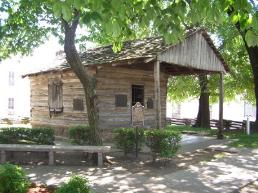
One-Room School of Albert Pike is on the Courthouse grounds
On December 28th the Federals emerged from the mountains at Dripping Springs in northern Crawford County. After a sharp skirmish there, they pursued retreating Confederates south into Van Buren. A running battle took place right through the center of town down the street directly in front of the historic courthouse. (Please click here to learn more about the Battle of Van Buren.)

Confederate forces across the river shelled Van Buren that afternoon, but the Crawford County Courthouse survived the battle. Thousands of pages of the county's records, however, were destroyed during the brief Union occupation.

A fire attributed to arsonists gutted the historic courthouse in 1877, sparking a fight between Van Buren and nearby Alma over which should be the county seat. Van Buren won and the courthouse was rebuilt within its still standing walls. It continues to serve the residents of Crawford County to this day.

To learn more about historic Van Buren, please visit www.exploresouthernhistory.com/vanburen.

Thursday, March 22, 2012

The Confederacy abandons Western Arkansas - March 22, 1862

Pea Ridge Battlefield
The shattering defeat suffered by the Confederate army of Major General Earl Van Dorn at the Battle of Pea Ridge ended, at least temporarily, Southern hopes of holding Northwest Arkansas.
By March 22, 1862 (150 years ago today), the remaining Confederate troops in the region had fallen back to Lee Creek in Crawford County and were preparing to leave the area for good. The Union army and navy were pressing on New Madrid and Island No. 10 on the Mississippi River and Van Dorn proposed to his commander, General P.G.T. Beauregard, that he march in support of the trapped garrison there.

Arkansas River at Van Buren
On March 21st he had informed Brigadier General Albert Pike, commanding in the Indian Territory, that he had "decided to march with this army against the enemy now invading the northeastern part of the State." Then on the 22nd, Major General J.P. McCown commanding at New Madrid and Island No. 10 was informed by Beauregard that, "Van Dorn proposes to attack enemy in reverse at New Madrid. Be of good cheer and hold out."

Riverfront Historical Marker at Van Buren
While waiting for instructions from Beauregard, Van Dorn began an immediate movement of his army for Northeast Arkansas. He left quickly and on March 22nd, 150 years ago today, his Assistant Adjutant-General D.H. Maury left Van Buren on the steamboat Lelia. Before leaving, Maury issued a plan of march to Major General Sterling Price:

...Please direct your march, via Clarksville, Dover, and Springfield (Conway County), toward Batesville, on White River. Expressmen will meet you on this road with instructions which will control you in the further march of your column. The troops of the advance post in Boston Mountains, on Lee's Creek, should not, of course, be relieved until the last moment, and when relieved should march with Greer's cavalry as the rear guard of the army. It is of the greatest importance that the troops of your command should reach White River at the earliest possible date. - Dabney H. Maury, CSA, March 22, 1862.

Gen. Dabney H. Maury
Maury went on to instruct Price to assume command that day of "matters in this vicinity preparatory to your march." Scouts were to be left behind to watch the Union army in Washington and Benton County and provide quick alerts should it begin to move. Cavalry regiments on the march from Texas to reinforce the army and within 50 miles of Van Buren were instructed to unite with Greer's cavalry brigade at Ozark.

The plan to strike against the Union army attacking Island No. 10 was a bold one, but would not happen. The Confederate defenses on the Mississippi River would crumble far faster than any of the Southern generals in the region could imagine.

The movement of Van Dorn's army, however, placed the western half of Arkansas in a terribly exposed position. With spring arriving, the entire Arkansas River valley from Little Rock to Fort Smith was now subject to Union conquest. Fort Smith was prepared for capture by the Federals and General Pike was ordered to act on the defensive in the Indian Nations. A time of great crisis was developing for the pro-secession people of the region.

Saturday, February 4, 2012

Pea Ridge #1 - Brigadier General Albert Pike

Brig. Gen. Albert Pike, C.S.A.
Library of Congress
Note: For the next six weeks I will focus on the 150th anniversary of the Battle of Pea Ridge, Arkansas. Be sure to check in regularly for new postings.
Perhaps the most enigmatic of all Confederate generals, Brigadier General Albert Pike was the commander of Southern forces in the Indian Nations of what is now Oklahoma when the Pea Ridge Campaign developed in 1862.

Born in Boston on December 29, 1809, Pike was the son of a cobbler and one of six children in a hard-working Massachusetts family. He attended public school where, in the tradition of that day, he received an excellent education that included studies in Hebrew, Latin and Greek as well as literature and mathematics. At the age of only 16 he passed the entrance exam for Harvard, but could not afford to go due to the cost of the tuition.

Instead of going on to college, Albert Pike becake a teacher and a poet. He published his first poem at the age of 23 and his work appeared in some of the leading literary journals of his day.

Albert Pike School in Van Buren, Arkansas
Like many Americans of the 19th century he was intrigued by the West. He relocated to Santa Fe, New Mexico (then part of Mexico), in 1831 and too part in an exploration of the headwaters of the Red and Arkansas Rivers. He soon appeared in Fort Smith and taught school for several years in the area. One of his one-room schoolhouses, in fact, still survives and can be seen on the grounds of the Crawford County Courthouse in Van Buren. Please click here to learn more.

Pike fought a Duel on the River in Fort Smith
Involved in politics and journalism before the war, Pike studied law during the antebellum era and represented clients including Creek and Choctaw Indians who had not been paid moneys due them from the U.S. Government. His military career began in 1846 when he joined 1,500 other Arkansans in volunteering for service in the Mexican War. He became embroiled in a controversy with Lieutenant Colonel Seldon Roane and after returning home the two fought a noted duel on the banks of the Arkansas River at Fort Smith. No one was injured in the exchange of fire and both men ended the contest with the honor intact.

Brig. Gen. Albert Pike, C.S.A.
National Park Service
When Arkansas left the Union in 1861, Albert Pike was named commissioner to the Indian nations. The Confederate government subsequently commissioned him as a brigadier general and gave him command of the Indian Territory. He was involved in raising Confederate troops among the Choctaw, Chickasaw, Creek, Cherokee and Seminole nations.

It was as a brigadier general in command of the troops from the Indian Nations that Pike would take part in the Battle of Pea Ridge, the largest action in which he would fight. In a dispute with General Thomas C. Hindman over which man commanded the forces and supplies in the Indian Territory, Pike resigned his post on July 12, 1862, just four months after the Battle of Pea Ridge.

Albert Pike is perhaps best known, however for his involvement with the Masonic Lodge. He became a Mason in 1850 and in 1859 became Grand Commander of the Supreme Council, Southern Jurisdiction, which made him the leader of all of the South's Masons. In 1871 he published Morals and Dogma for the Scottish Rite and later penned several other books on Masonry. Appropriately he died at the Scottish Rite Temple in Washington, D.C. on April 2, 1891 and is now buried in a crypt inside the temple.

General Albert Pike would play a signficant and controversial role in the Battle of Pea Ridge and his involvement in the campaign will be dealt with extensively over coming days and weeks. You can learn about his little one-room school in Van Buren by visiting www.exploresouthernhistory.com/pikeschoolhouse.

Saturday, January 21, 2012

January 21, 1862 - Rumors in Rolla

Gen. Samuel Curtiss
National Archives
The  situation in Northwest Arkansas and Southwest Missouri began to reach its critical point during the third week of January, 1862.
Union General Samuel Curtis still in Rolla, preparing to begin his final advance on Springfield and the Arkansas border, while Confederates in the region were still not ready for a major fight. Gen. Sterling Price was still in Springfield with the Missouri State Guard. "Old Pap," as he was called by his men, was still not a regular Confederate general, but held his rank only in his state's pro-secession militia.

Meanwhile, scouts and pro-Union citizens continued to flow into the Federal lines, bringing intelligence on the situation in Springfield and beyond. One such citizen arrived at the beginning of the third week of March with wide-ranging information on Confederate activity as far south as the Arkansas River Valley:

   ...[I]t was reported that 170 or 200 rebels were encamped at the head of Spring River, en route for Cassville.
   In regard to the number of troops in Northern Arkansas, he says he had it from good authority that there were only 500 or 600 at Cross Hollows and Cave Hill [i.e. Springs], Benton County. But a body of 5,000 men were at Tilsforth Bend, about 50 miles below Van Bergen [i.e. Van Buren], on the Arkansas river.
   Several secessionists told him that Price's forces at Springfield did not exceed 10,000.
   This gentleman met the scouts of the federal army beyond Lebanon, and other troops at different points this side. - Providence Evening Press, January 27, 1862.
Ozarks of Southwest Missouri

The report that the Missouri State Guard included 10,000 men or less was one of the first to accurately estimate Price's effective strength. Most previous reports had wildly exaggerated the strength of his force.

The citizen did, however, seriously under-estimate the number of Confederates then in Northwest Arkansas. The actual number was closer to 4,000 than the 500-600 he reported, with another few thousand Confederate cavalrymen just across the Boston Mountains in and around Van Buren and Fort Smith.

Such intelligence would continue to come in as both sides prepared for a campaign that would end in early March at the Battle of Pea Ridge, Arkansas. I will continue posting on the campaign over coming weeks, so be sure to check back often. You can always learn more about the Battle of Pea Ridge at www.exploresouthernhistory.com/pearidgeindex.

Thursday, January 19, 2012

January 1862 - Prelude to Pea Ridge

Pea Ridge National Military Park
This year marks the 150th anniversary of the Battle of Pea Ridge, Arkansas, not just one of the largest battles west of the Mississippi, but one of the most significant actions of the entire Civil War.
As part of the commemoration of this battle that preserved Missouri for the Union, I will be posting throughout January, February and March on the Pea Ridge campaign, using as often as possible the words of the soldiers, generals and civilians that witnessed it. Be sure to check back regularly for the latest posts.

Curtis
To try to set the stage as well as I can, the Pea Ridge Campaign began to develop in January of 1862 as two armies began to assemble for battle. The Union army, commanded by Gen. Samuel Curtis, was centered at Rolla, Missouri, a town about 112 miles northeast of Springfield. Curtis was determined to drive Confederate forces, particularly the Missouri State Guard under Gen. Sterling Price, from Missouri and fully establish control over the state, which was very divided in its loyalties.

The Confederates, in turn, were equally determined not only to hold at least part of Missouri if possible, but to stop Curtis from advancing into Arkansas. In mid-January of 1862, however, their forces were scattered and had yet to assemble for battle. The Missouri State Guard, under Price, was clinging to its position at Springfield, Missouri. Gen. Price knew, however, that he could not hold there against Curtis's much larger army.

Price
The Missouri general for more than one month had been begging for help from Arkansas. A force of 3,000-4,000 Confederates were centered around Fayetteville in Northwest Arkansas under Gen. Ben McCulloch. Unfortunately, Price and McCulloch did not get along. Not only would the latter general not reinforce Price, he had gone to Richmond to discuss the situation with officials there, leaving Col. Louis Hebert of Louisiana in command. Hebert promised Price that he would reinforce him in an emergency and did his best to get supplies through to the State Guard, but otherwise maintained his force in its winter quarters around Fayetteville.

To the south in the Arkansas River valley, Gen. James McIntosh commanded a large cavalry force that was wintering around Van Burn and Fort Smith. He had declined a request from Price for help in December and gone instead to support Col. D.H. Cooper in the Cherokee Nation where he had won the Battle of Chustenahlah several weeks earlier.

Van Dorn
To try to end the confusion and bickering in the West, President Jefferson Davis appointed Major General Earl Van Dorn as head of what he would style the "Army of the West." Van Dorn was not yet on the scene in mid-January, but was heading that way. He was not thinking of just halting Curtis, he had dreams of a major offensive campaign. He told his wife on the day of his appointment that he "must have St. Louis."

To Van Dorn would fall the task of pulling together the three major Confederate forces then assembled in Missouri and Arkansas and leading them into battle. He would receive support from Gen. Albert Pike's brigade of Southern-allied Indian troops.

I will continue to post on the Pea Ridge Campaign throughout the coming weeks. To read more about the battle itself, please visit www.exploresouthernhistory.com/pearidgeindex.

Friday, December 9, 2011

Historic Sites of the Prairie Grove Campaign

Prairie Grove Battlefield State Park
I've spent the last three weeks looking at events associated with the Battle of Prairie Grove and the Prairie Grove Campaign, which took place 149 years ago this year. I thought telling you about some of the sites of the campaign as they appear today might be a good way to wrap up the series.

I have arranged these in order beginning with Prairie Grove battlefield.


Borden Orchard at Prairie Grove Battlefield
Prairie Grove Battlefield State Park

One of America's most beautifully maintained Civil War sites, Prairie Grove Battlefield is a state and national historical treasure. Located at 506 E. Douglas Street in Prairie Grove, Arkansas, the park is only 18 minutes from downtown Fayetteville. From I-540 through Northwest Arkansas, take the Farmington exit (#62) and follow U.S. 62 West 9 miles to the battlefield.

The park preserves the scene of some of the heaviest fighting of the Battle of Prairie Grove, including the right flank of the Confederate line where Herron launched his bloody assaults, the Borden house and orchard (the house was rebuilt by the family after the war on the same foundations) and the ground across which Herron's attacks were launched. A number of historic structures are preserved at the park, which also features a museum, interpretive panels, cannon, monuments and a one-mile Battlefield Trail that loops through areas of heavy fighting. A driving tour takes visitors to other key points of the battlefield, including an overlook on the western end of the battlefield.

The park is open daily from 8 a.m. until one hour after sunset and also offers a picnic area, playground, restrooms, etc.  To learn more, please visit the park service website at: http://www.arkansasstateparks.com/prairiegrovebattlefield/.

You can read more about the battle and see photos of the battlefield at www.exploresouthernhistory.com/ArkansasPG1.


Battle of Cane Hill Historical Marker
Cane Hill Battlefield

While the Cane Hill Battlefield has not been developed as a park, efforts are currently underway to create a driving tour and install interpretive signage. The first of the panels are now up, including one at the town cemetery.

To reach Canehill (as it is spelled today) from Prairie Grove, follow U.S. 62 West for 4.8 miles then turn left (south) on AR-45 and follow it for 3.4 miles. There is a Battle of Cane Hill marker on AR-45. Be sure to see the interpretive panel at the cemetery and check out the historic Cane Hill College building on College Road one block west of AR-45. The existing building was built shortly after the Civil War, but the college was a major facility for learning when the war broke out.

Cane Hill Battlefield
The Battle of Cane Hill began just north of the college and flowed south for miles into the mountains. To view the battlefield from the highway, travel south along AR-45 for two miles to the intersection with Clyde Road. This drive takes you along the battlefield and you can view the terrain across which it was fought. The battle continued down what is now Clyde Road.

To follow the course of the fighting, follow Clyde Road for 1.4 miles to Four Corner Road. Turn left on Four Corner Road and follow it up and over Reed's Mountain (see below) for 4.4 miles to Cove Creek Road at the site of Morrow's Station (see below).  As you pass up and over the mountain, you are driving through one of the scenes of heavy fighting. Once you reach Cove Creek Road, turn right and drive until the road passes through a narrow area between the creek on your left and a rocky bluff on your right. This was the scene of the Confederate ambush that closed the fighting.

Please keep in mind that once you leaved the pavement, some of these dirt roads can be slick and difficult to travel during raining weather. Please exercise caution.

The staff at Prairie Grove Battlefield State Park can provide additional information on the Battle of Cane Hill. You can also learn more at www.exploresouthernhistory.com/ARCaneHill.


Reed's Mountain looking down to Morrow's Station
Reed's Mountain Battlefield

To reach the scene of the Reed's Mountain fight from Canehill, follow the directions given above for the Cane Hill Battlefield. The fighting took place along both sides of what is now Four Corner Road from the crest of the mountain down to the intersection with Cove Creek Road. There are no markers or other interpretation at the site. Please click here to learn more about the battle: www.exploresouthernhistory.com/ARReedsMountain.


Morrow's Station

Morrow's Station was located around the modern intersection of Four Corner Road and Cove Creek Road. It is often confused with the nearby town of Morrow, which also existed in 1862, but was actually at this site. There are no markers or other interpretation at the crossroads, but the Morrow Cemetery still exists just west of the intersection.

To reach Morrow's Station, follow the directions above for the Cane Hill Battlefield.


Cove Creek Road
Cove Creek Road

Cove Creek Road can be followed south from the Morrow's Station site into Crawford County or north from that point back to Prairie Grove. This was the main route followed by the Confederate army as it both advanced to and departed from the Battle of Prairie Grove.


Dripping Springs
Dripping Springs

To reach Dripping Springs, site of the Confederate cavalry camps, without getting lost in a myriad of small roads, I recommend that you retrace your steps from Cove Creek Road (as given above under Cane Hill Battlefield) back to the intersection of Clyde Road and AR 45. Turn left (south) on AR 45.

Follow AR 45 for 5.7 miles to the intersection with AR 59 at Dutch Mills. This community was an important landmark of the Civil War in Northwest Arkansas. Turn left on AR 59 and follow it south for 29 miles. Along the way you will pass through the stateline community of Evansville, to which Colonel Stand Watie advanced with his brigade of Confederate Cherokee during the campaign. Just south of Cedarville, look for the intersection with Uniontown Highway. A marker for the later Battle of Dripping Springs (fought later in December of 1862) can be seen just to the left of the intersection.

Turn right on Uniontown Highway and follow it roughly one mile to its intersection with Dripping Spring Road. Turn left on Dripping Spring Road and follow it for 6/10 of a mile to its intersection with Beverly Hills Drive and Old Uniontown Road. This is the site of Dripping Springs.

The Confederate cavalry camps were primarily on the hill to your left and the little spring that gives the crossroads its name is on private land to your right just beyond Old Uniontown Road. There are no markers at the site.


Confederate Section at Fairview Cemetery
Fairview Cemetery at Van Buren

To reach Fairview Cemetery at Van Buren from Dripping Springs, follow Old Uniontown Road for 4.4 miles to its intersection with AR 59.  Turn right on AR 59 and follow it for 2.7 miles until you see Fairview Cemetery on your left just after you travel down a steep hill.

In the Confederate section of Fairview Cemetery (in the northeast corner of the cemetery), you will find the graves of many of the Confederate wounded who died after the battle. Taken back to hospitals in Van Buren, they lingered in pain for weeks and months. A monument commemorates the role of these men in a series of battles including Wilson's Creek (Oak Hill), Pea Ridge, Prairie Grove, etc.

Be sure to take time to walk through other areas of the historic cemetery, where you will find the graves of many people of importance to early Arkansas history.  To learn more about Fairview Cemetery, please visit www.exploresouthernhistory.com/fairviewcemetery.html.


Main Street in Van Buren
Van Buren

From Fairview Cemetery, follow AR 59 (Fayetteville Road) south for three blocks to the train depot at Main Street.  The depot provides a great view down Main Street through the center of town.

Van Buren was the launching point for the Prairie Grove Campaign and was General Hindman's headquarters during the early stages of the campaign. It is now a charming, historic town with numerous shops, restaurants and other points of interest downtown. The historic Crawford County Courthouse a few blocks south on Main Street is of pre-Civil War construction and was a landmark of Van Buren at the time of the campaign. On its grounds can be found historical markers, monuments and the original log schoolhouse where Masonic leader and Confederate general Albert Pike once taught school. A park borders the Arkansas River at the south end of Main Street. 

Take some time and enjoy Van Buren and what this heritage minded city has to offer.  To learn more about Van Buren's history, please visit www.exploresouthernhistory.com/vanburen.


Barracks Building at Fort Smith
Fort Smith National Historic Site

Directly across the Arkansas River from Van Buren is the historic city of Fort Smith. The original
barracks and quartermaster's storehouse buildings of the fort still stand at Fort Smith National Historic Site.

The fort was used as a supply depot and command center by both Union and Confederate forces during the Civil War and its museum features an outstanding exhibit on the Civil War in and around Fort Smith.

To learn more, please visit www.exploresouthernhistory.com/fortsmith.html.


In addition to the sites I've discussed here, Fayetteville National Cemetery and Fayetteville Confederate Cemetery are definitely worth visiting. The remains of Union soldiers killed at Prairie Grove and Cane Hill are at the national cemetery, while the Confederate cemetery contains the graves of Confederate soliders killed in those fights.

Fayetteville Confederate Cemetery:  www.exploresouthernhistory.com/fayettevillecc.html

Fayetteville National Cemetery:  www.exploresouthernhistory.com/arfayettevillenc.html

And, as always, you can learn more about the Prairie Grove Campaign at www.exploresouthernhistory.com/ArkansasPG1.

Sunday, December 4, 2011

December 4, 1862: The March to Prairie Grove Continues...

Road followed by part of Hindman's Army
The more than 11,000 Confederates of General Thomas C. Hindman's Corps continued to move north from Van Buren 149 years ago today, pushing past Dripping Springs and into the edge of the mountains.
By nightfall the slow moving army had reached Oliver's store, then a well known landmark in northern Crawford County. Located north of Dripping Springs at the point where several roads merged as they came down out of the mountains, Oliver's was often mentioned in the reports of both armies during the Civil War. Hindman brought his men to a halt here and allowed them to rest as best they could through the night of December 4th.

They were so exhausted that they probably slept some, but hunger and cold kept many of them awake. His ill-supplied force was simply not able to move at the pace that Hindman had hoped, but he wisely opted not to repeat the mistakes made by Confederates earlier in the year when they outran their supplies and exhausted themselves prior to the Battle of Pea Ridge. The night of the 4th, then, was spent letting the men rest and eat as best as they could while his supply wagons and artillery came up.

View from Reeds Mountain down to Morrow's Station
Marmaduke's cavalry, numbering about 2,000, was pushed into the Boston Mountains on the 4th to watch for any signs of enemy scounting parties and also to check the condition of the roads. Hindman hopes to advance as far as Morrow's House the next day.

Morrow's House, or Morrow's Station, was actually a small settlement on Cove Creek a few miles southeast of Cane Hill (today spelled Canehill). The site is often confused with the modern community of Morrow, which is number of miles west of the point targeted by Hindman in 1862. Important roads then had stopping points or stations where travelers could get food for themselves and their horses or stop for the night. Morrow's Station was one such point, located where the road coming down Reeds Mountain from Cane Hill intersected with the Cove Creek Road.

1880 Map of Cane Hill area.
Morrow's Station is at lower right.
Morrow's Station was an important strategic point for Hindman. If he could get his army across the mountains and emerge there before the Union army knew he was coming, he would be in an excellent position for the coming battle. 

The Confederate general's plan was to concentrate his force at Morrow's Station. Marmaduke's cavalry would then continue up the Cove Creek Road and then turn northwest on the Maysville Road. This would allow the Southern horsemen to hit General Blunt's Union army on its left flank and from the rear.  At the same time, Hindman would advance with the infantry and most of the artillery up the road over Reeds Mountain and hit the Federals head on from excellent ground. If he could move as planned, the Confederate commander had a good chance of smashing the Union force occupying Cane Hill.

I will continue posting on the Prairie Grove Campaign over coming days, so be sure to check back regularly. To learn more until then, please visit www.exploresouthernhistory.com/ArkansasPG1.

Also be sure to scroll down here to read more about the early stages of the campaign.

Wednesday, November 30, 2011

November 30, 1862 - Confederate Cavalry returns to Dripping Springs

Dripping Springs, Arkansas
Having been pushed out of their advanced position in the fighting on the 28th (see The Battle of Cane Hill), General John S. Marmaduke and his three brigades of Confederate cavalry returned to their camps at Dripping Springs on November 30, 1862, 149 years ago today.
Located about 9 miles north of the historic Crawford County Courthouse in Van Buren, Dripping Springs takes its name from a spring that bubbles from a hillside. Because it allowed Confederate cavalry to watch the key roads leading south over the Boston Mountains to Van Buren and the Arkanasas River, the crossroads was a key position for the placement of Marmaduke's small division.

Gen. Thomas C. Hindman, C.S.A.
Across the mountains to the north, General James G. Blunt and his Union army settled into new camps at Cane Hill. Blunt did not know it, but his decision to remain at this point created a window of opportunity for the overall Confederate commander at Van Buren, General Thomas Hindman.

Hindman had enough ammunition for one good battle and only enough supplies to maintain his position at Van Buren and Fort Smith for a short time longer before he would be forced to move his command down the Arkansas River to Little Rock in order to obtain provisions and other necessities. He hoped to accomplish something significant before being forced to withdraw and was carefully watching the positioning of Union troops in Northwest Arkansas.

Van Buren and the Arkansas River
As seen from Logtown Hill
When Blunt established his new camp at Cane Hill instead of returning to Camp Babcock north of Siloam Springs, he placed himself almost beyond reach of reinforcements. Since Hindman knew he had little chance of prevailing if the Blunt's command was reinforced by General Francis J. Herron's division, then in southern Missouri, he was hoping for a chance to strike one of the two forces and destroy it before the other could reinforce it. Blunt provided him that opportunity and he began making immediate preparations to take advantage of it.

Over the next two days, the Confederate forces at Van Buren and Dripping Springs did everything they could to get their arms, supplies and horses ready for a move in force across the Boston Mountains. Hindman hoped to corner Blunt at Cane Hill and destroy him. Using ammunition captured in this battle, he could then turn on Herron's division as it came down from Missouri to save Blunt.

It was an interesting plan with a reasonable prospect of success.  It would lead seven days later to the massive Battle of Prairie Grove.

I will continue posting on the Prairie Grove Campaign over coming days, so be sure to check back regularly.  Until the next post, you can read more about the Battle of Prairie Grove at www.exploresouthernhistory.com/ArkansasPG1.

Thursday, November 24, 2011

November 24, 1862: Marmaduke crosses the Mountains

Edge of the Boston Mountains at Canehill
Following on the heels of the Union cavalry's reconnaissance to Van Buren (see yesterday's post), General John S. Marmaduke was ordered to follow it back across the Boston Mountains with his three brigades of Confederate horsemen.
Moving up the Cove Creek Road from the Dripping Springs area of Crawford County less than 24 hours after 600 Federals withdrew back across the mountains, Marmaduke emerged from the mountains at Cane Hill on November 24, 1862 (149 years ago today).

Combined, the three brigades under Marmaduke's command should have numbered well above 5,000 men, but this was not the case. A good example can be found in the reports of Colonel Charles A. Carroll's Arkansas Brigade. While his force on paper should have numbered some 1,700 men, Carroll had only 517. Of this number, in fact, only 200 were reported as "effective" while the remaining 317 were either sick or mounted on horses too worn down to be fit for service.

Looking down into Cove Creek Valley
The other Confederate brigades were in no better shape and Marmaduke's force moved up to Cane Hill at perhaps one-third strength. He did not even have sufficient horses to move his batteries of light artillery across the mountains.

It was a dangerous move to put a weak force within striking distance General James G. Blunt's Union Division in Northwest Arkansas, but Confederate commanders believed it to be a necessary one as they continued to prepare their full army for a move across the mountains.

Cane Hill (now spelled Canehill), which was occupied by Marmaduke's men on the night of the 24th, was then one of the most important communities in Northwest Arkansas. In the center of an agricultural area just above the mountains and about 20 miles southwest of Fayetteville, it was home to Cane Hill College, a mill and a small business community:

Cane Hill College (Post-War Building)
…Cane Hill is a ridge of perhaps 8 miles length and 5 miles width, in the southwest part of Washington County, Arkansas, just beyond the north base of the Boston Mountains. Three villages are built upon it (Russellville, Boonsborough, and Newburg), which almost blend with each other, covering a distance, as the road to Fayetteville runs, of 3 or 5 miles…. The distance from Van Buren to Newburg is 45 miles. The intermediate country is a rugged and sterile range of mountains. - Maj. Gen. Thomas C. Hindman, C.S.A., Dec. 15, 1862.

Each of the three Confederate brigades pitched camp in one of the three small villages at Cane Hill, with the northern-most camped near the Cane Hill College buildings. These positions taken, the Southern commanders pushed heavy patrols of their own north along the roads to look for any signs of Union forces in the area. Some minor skirmishing would take place the next day.

I will continue posting on the Prairie Grove Campaign over coming days, so be sure to check back through the holiday weekend for more.  Until the next post, you can read more at www.exploresouthernhistory.com/ArkansasPG1.

Wednesday, November 23, 2011

November 23, 1862: Reconnaissance toward Van Buren

Site of Confederate Camps
Dripping Springs, Arkansas
As the Confederate army of General Thomas Hindman continued its preparations for an advance into Northwest Arkansas, Federal forces made an unexpected probe of their advanced cavalry camps 149 years ago today.

Please click here to read the post of November 17th, detailing the activity underway in Van Buren).

Sent south across the Boston Mountains by Union General James G. Blunt, a force of 600 cavalrymen approached the camps of Confederate General John S. Marmaduke's cavalry command at Dripping Springs in Crawford County. Dripping Springs is about 9 miles north of the Crawford County Courthouse in downtown Van Buren. Using the twisting roads of the day, the distance was a little longer.

Cove Creek Road, used by Union Cavalry
The Federals approached the Confederate outer camps to scout the activities underway at Van Buren in an effort to learn the size and intent of the Confederate army.  There was some minor skirmishing near Dripping Springs. The approach of the Union cavalry was unexpected and the Southern horsemen fell back before them, unsure if the approach of Lt. Col. L.R. Jewell and his men marked the front of a full scale movement by the Federal army in Northwest Arkansas.  It did not.

When it became apparent that the Federals were not supported by infantry, Confederate resistance stiffened. Jewell now hesitated and, realizing the Confederates were present in Van Buren in force, began a withdrawal back into the mountains.

Pasture and Mountains at Dripping Springs
He and his horsemen returned back across the Boston Mountains during the afternoon and evening and reached Blunt's camps that night. Neither side reported any casualties.

The value of the reconnaissance is unclear. Jewell did not learn much about what was going on in Van Buren and even after his probe, Blunt still estimated the strength of Hindman's Confederate army at anywhere from 11,000 to 30,000 men.

The raid did lead, however, to the first fighting of the Prairie Grove campaign when Hindman ordered Marmaduke's cavalry to move north on the heels of the Union horsemen and take a position at Cane Hill in Washington County.

I will continue following the events of the Prairie Grove Campaign over the holiday weekend, so be sure to check back in occasionally. 

Have a Happy and Blessed Thanksgiving!

To learn more about the Battle of Prairie Grove, please visit www.exploresouthernhistory.com/ArkansasPG1.

Thursday, November 17, 2011

Van Buren, Arkansas - Before the Battle of Prairie Grove

Crawford County Courthouse in Van Buren
In November of 1862, Confederate General Thomas Hindman began to prepare for a move from the Arkansas River Valley across the Boston Mountains into the Ozarks Plateau of Northwest Arkansas. He hoped to return a large area of Arkansas to Confederate control, while also opening the door for further operations into Missouri.
The launching point for this planned campaign was Van Buren, a charming town on the Arkansas River. The location of important steamboat landings and a ferry that crossed over to Fort Smith, Van Buren had supported the Southern cause since the earliest days of secession.

Militia troops from the city had joined in the taking of Fort Smith from U.S. forces in 1861 and it had served as a base of operations for troops moving north across the mountains before both the Battle of Wilson's Creek and the Battle of Pea Ridge. Wounded Confederate soldiers were brought back to Van Buren after both battles and the graves of those that did not survive can be seen today in rows at Fairview Cemetery.

Van Buren from above.
In November of 1862, Van Buren took on a critical role as Hindman planned his move into Northwest Arkansas. A large force of cavalry was positioned just north of town under General John S. Marmaduke. His command included Captain William Clark Quantrill's Missouri guerrillas. Jesse James, then only 14, was not yet part of the command, but other men with names that still echo through history were there. Among them were Frank James and Cole Younger.

Downtown Van Buren, Arkansas
With Markaduke's command in place to block in Federal movement or probe on Van Buren, Hindman began stockpiling provisions, ammunition and other supplies in the city. These would be used by his army as it crossed over the mountains. Troops also began the slow process of moving across the Arkansas River from their camps on Massard Prairie. They knew that combat was coming, but did not yet know that they would remember the name "Prairie Grove" for the rest of their lives.

I will continue posting on the Prairie Grove Campaign over coming weeks.  Until the next post, you can read more about historic Van Buren at www.exploresouthernhistory.com/vanburen.

Read more about the Battle of Prairie Grove at www.exploresouthernhistory.com/ArkansasPG1.

Wednesday, January 19, 2011

January 5, 1861 - Mass Meeting in Van Buren

Crawford County Courthouse in Van Buren
The following appeared on page 5 of the January 7, 1861, issue of the Philadelphia Inquirer and details a mass meeting that took place in Van Buren in support of the secession of Arkansas from the Union:

SECESSION MEETING AT VAN BUREN.

VAN BUREN, ARK., January 5 – The largest meeting ever held in Crawford county took place to-day, HENRY WALCOX presided. A series of resolutions were adopted nearly unanimously, declaring that the institutions of the slaveholding States ought to be maintained at every hazard and to the last extremity; that we view the personal liberty bills, passed for the purpose of defeating the execution of the Fugitive Slave law, as palpable infractions of the Constitution, and that we insist on their speedy repeal, and the faithful execution of said law as a condition to the restoration of fraternal relations; that it is our ardent desire to preserve the Union, if it can be preserved consistently with the honor, rights and interests of the slaveholding States, and favor a conference of the slaveholding States at Nashville, and, if need be, a convention of all the States, that, in the event of a failure by the South to obtain such a guaranty of their rights in the Union as may be compatible with its honor and interests, that they then insist upon an equitable division of the public property and the public debt, and if this cannot be obtained, they will separate from their Northern confederates, not peaceably, but that they will draw the sword and fight for the rights to the bitter end; that we are opposed to separate action, and especially the secession of Arkansas without co-operation; that a reasonable time should be given to the non-slave-holding States to retrace their steps and depose their unprincipled leaders, and give the South such guarantees as will secure their rights and equality in the Union; that though deploring the election of Mr. LINCOLN, we unhesitatingly declare that it is not, in itself, sufficient cause for a dissolution of the Union; that we tender our thanks to Messrs. CRITTENDEN, BIGLER, RUST, and others for their efforts in Congress to heal the unhappy dissensions which have arisen between the North and South, and to preserve the Federal Union consistently with the rights and honor of all the States; that we are in favor of a State Convention at an early day, and that we recommend to the Legislature an increase of ad valorem duties to forty-five cents on the $100, which will furnish resources to defray the purchase of arms and munitions of war, with which to protect our lives and our homes from aggression and menace.

You can learn more about Van Buren at www.exploresouthernhistory.com/vanburen.

Thursday, March 18, 2010

Interesting Account of the Battle of Van Buren, Arkansas

The following is a report on the Battle of Van Buren (December 28, 1862) that appeared in a Maine newspaper just four days later. The speed with which reports of battles in western Arkansas reached newspapers in the far Northeast is remarkable when it is considered that just a few years before, it would have taken weeks for the news to arrive. The report was datelined Fayetteville, December 31, 1862:

January 1, 1863
Portland (Maine) Daily Advertiser, page 2.

Additional particulars of the raid to Van Buren have been received. Our army was 10 miles this side of Van Buren yesterday, and would bivouac on the mountain top last night, and expected to reach Prairie Grove again today. Gen. Schofield joined them a few miles beyond the foot of the mountain. The steamers violet, Rose Douglas, Frederick Mortrede [Nortrobe], Erie, No. 6, and Van Buren, with their cargoes of grain and provisions for the rebel army, were burned, also a large amount of army stores. The rebels burned their arsenal and ferry boats at fort Smith, to prevent them from falling into our hands; also a large quantity of provisions on the opposite bank of the river. A general conflagration was in progress when our forces left.

The raid on Van Buren clearly demonstrated the shattered condition of the Confederate Army of the Trans-Mississippi, despite the fact that it had fought a superior Union force to a draw at the Battle of Prairie Grove just a little mor than two weeks earlier. The capture of the Arkansas River town was a major blow to the prestige of Confederate forces in the area, although the Federals were unable to permanently exploit their ability to cross the mountains and withdrew back to their camps in Northwest Arkansas for the winter.

To learn more about the Battle of Van Buren, please visit www.exploresouthernhistory.com/vanburenbattle1.

Friday, January 8, 2010

Confederate Section of Fairview Cemetery - Van Buren, Arkansas


A walk through the Confederate Section of Van Buren's picturesque Fairview Cemetery provides a haunting reminder of just how brutal the year 1862 was for the Southern forces in Arkansas.

Row after row of headstones, many of them marked as "Unknown," bring a great deal of reality to the brutal cost of the Pea Ridge and Prairie Grove Campaigns. This is especially true because, with a few exceptions, the men and boys buried here did not die in combat. Instead, they suffered from horrible battle wounds and debilitating disease. Often linger in misery for days and weeks before finally breathing their last.

These men were the hard luck soldiers of the Western frontier. Some of them marched through winter snows and ice with no shoes and threadbare uniforms literally falling off of their emaciated bodies as they followed Van Dorn to Pea Ridge and Hindman to Prairie Grove. Unlike many others, they did not desert and slip away into the mountains or through the lines to join the Federal forces. Instead they stood their ground and fought fiercely and bravely for the cause in which they believed.

Walking the beautifully preserved and landscaped battlefields of Prairie Grove and Pea Ridge today, it is difficult to really conceive the brutality that took place on such picturesque fields and ridges. But a walk through Fairview provides a sobering reminder of just how brutal the war was for the men in the ranks.

To learn more about the cemetery, which is listed on the National Register of Historic Places, please visit www.exploresouthernhistory.com/fairviewcemetery.

Thursday, January 7, 2010

Albert Pike's School House - Van Buren, Arkansas


A little log one-room schoolhouse now preserved on the grounds of the Crawford County Courthouse in Van Buren holds a unique place in American history. Albert Pike once taught there.

A major figure in Arkansas in the years before the War Between the States, Pike was opposed to the secession of the Southern states, but served the Confederacy as a brigadier general. By the time he received his appointment in November of 1861, however,

he was already a noted explorer, lawyer, poet, writer, educator and soldier.

A native of Massachusetts, Albert Pike had arrived west of the Mississippi in 1831, spending time in St. Louis and Independence, Missouri, before joining several major hunting and trading expeditions into Texas and New Mexico. In 1833 he accepted a job teaching at the log school that can be seen today in Van Buren.


It is thought that the structure was built in around 1820, making it one of the oldest sta

nding buildings in Arkansas. Pike did not teach long before moving on to Little Rock where he engaged on a career in law, journalism and politics. He became a nationally known writer and poet in the Antebellum era.

His career as a Confederate general was brief. Assigned to command in the Indian Nations in what is now Oklahoma

, he led Native American troops at the Battle of Pea Ridge. He became involved in a conflict with General Thomas Hindman, however, and resigned his commission the following year.

Pike sat out the rest of the war, living part of the time in the Ouachita Mountains. In later years he continued his work in Freemasonry, which he had begun in the 1840s. He eventually became a 33rd degree Mason and is regarded as the father of modern Freemasonry.

To learn more about Albert Pike's School House in Van Buren, please visit www.exploresouthernhistory.com/pikeschoolhouse.