Showing posts with label creek. Show all posts

Tuesday, March 13, 2012

March 13, 1862 - A Link Between Pea Ridge and Horseshoe Bend

Gen. Ben McCulloch, CSA
Among the remarkable connections that thread their way through Southern history is the story of the son of a soldier of the Battle of Horseshoe Bend who lost his life while commanding a Confederate division that included soldiers from the CherokeeNation.
Brigadier General Ben McCulloch fell on March 7, 1862, at the Battle of Pea Ridge, Arkansas. The commander of one of the two Confederate divisions engaged in that battle, McCulloch led a force that included Brigadier General Albert Pike's brigade from the Indian Territory. Among the men in Pike's brigade were warriors from the Cherokee, Choctaw, Chickasaw and Creek Nations.

McCulloch, in turn, was the son of Lieutenant Alexander McCulloch, an officer in the army of Major General Andrew Jackson at the Battle of Horseshoe Bend, Alabama. Horseshoe Bend, many believe, started the Creek Nation on a road that would lead to its forced removal to what is now Oklahoma just three decades later. A large force of Cherokee warriors fought on Jackson's side in that battle and figured prominently in his victory.
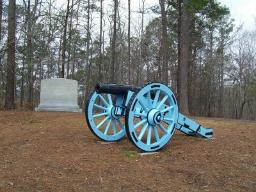
Gun Hill at Horseshoe Bend Battlefield
McCulloch's father fought at the Alabama battle.
Fought on March 27, 1814, the Battle of Horseshoe Bend was a bloody defeat for the followers of the Red Stick movement within the Creek Nation. Led by Jackson in person, a U.S. Army stormed Red Stick fortifications at the town of Tohopeka. Most of the warriors fought to the death, prompting one eyewitness to observe that the Tallapoosa River "ran red with blood." More than 800 Creek warriors died, while Jackson's force suffered losses of 49 killed and 154 wounded.

In addition to Alexander McCulloch, noteworthy individuals on the field included Sam Houston, Sequoyah, Menawa, Major Ridge, William McIntosh and others. The famed frontiersman Davy Crockett once claimed to have been there, but was not. (Note: Crockett did fight in other battles of the Creek War).

Leetown Area of Pea Ridge Battlefield
McCulloch fell while leading the Confederate attack at Leetown.
On March 13, 1862, the New Orleans Times-Picayune memorialized General Ben McCulloch in a column that reminded readers of his father as well:

Ben McCulloch, whose loss on the field of battle will be mourned by his countrymen, was the son of Alexander McCulloch, who was a lieutenant and aid to Gen. Coffee, of Tennessee, in the battles of Talladega and Horse Shoe Bend, and who resigned his commission in March, 1814.
Ben was born in Rutherford county, Tenn., in 1814. He was a captain of Texas Rangers in the Mexican war, and was distinguished for courage and conduct in the battle of Monterey. On the 11th of July, 1846, he was appointed quartermaster, with the rank of major. He was also distinguished in the battle of Buena Vista, and as the commander of a spy company, before that battle, for a most daring and successful reconnoisance. He resigned his staff appointment in 1847. At his death he was a brigadier general, commanding a division, and chiefly composed of Arkansas and Texas troops. The 3d Louisiana, Col. Hebert, was attached to this division.

General Ben McCulloch was first buried on the battlefield at Pea Ridge, but his body rests today at the Texas State Cemetery in Austin.
To learn more about the Battle of Horseshoe Bend, please visit www.exploresouthernhistory.com/AlabamaHSB.
To learn more about the Battle of Pea Ridge,  please visit www.exploresouthernhistory.com/pearidgeindex.

Saturday, February 4, 2012

Pea Ridge #1 - Brigadier General Albert Pike

Brig. Gen. Albert Pike, C.S.A.
Library of Congress
Note: For the next six weeks I will focus on the 150th anniversary of the Battle of Pea Ridge, Arkansas. Be sure to check in regularly for new postings.
Perhaps the most enigmatic of all Confederate generals, Brigadier General Albert Pike was the commander of Southern forces in the Indian Nations of what is now Oklahoma when the Pea Ridge Campaign developed in 1862.

Born in Boston on December 29, 1809, Pike was the son of a cobbler and one of six children in a hard-working Massachusetts family. He attended public school where, in the tradition of that day, he received an excellent education that included studies in Hebrew, Latin and Greek as well as literature and mathematics. At the age of only 16 he passed the entrance exam for Harvard, but could not afford to go due to the cost of the tuition.

Instead of going on to college, Albert Pike becake a teacher and a poet. He published his first poem at the age of 23 and his work appeared in some of the leading literary journals of his day.

Albert Pike School in Van Buren, Arkansas
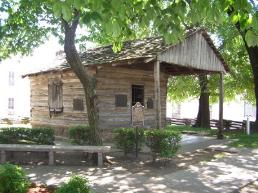
Like many Americans of the 19th century he was intrigued by the West. He relocated to Santa Fe, New Mexico (then part of Mexico), in 1831 and too part in an exploration of the headwaters of the Red and Arkansas Rivers. He soon appeared in Fort Smith and taught school for several years in the area. One of his one-room schoolhouses, in fact, still survives and can be seen on the grounds of the Crawford County Courthouse in Van Buren. Please click here to learn more.

Pike fought a Duel on the River in Fort Smith
Involved in politics and journalism before the war, Pike studied law during the antebellum era and represented clients including Creek and Choctaw Indians who had not been paid moneys due them from the U.S. Government. His military career began in 1846 when he joined 1,500 other Arkansans in volunteering for service in the Mexican War. He became embroiled in a controversy with Lieutenant Colonel Seldon Roane and after returning home the two fought a noted duel on the banks of the Arkansas River at Fort Smith. No one was injured in the exchange of fire and both men ended the contest with the honor intact.

Brig. Gen. Albert Pike, C.S.A.
National Park Service
When Arkansas left the Union in 1861, Albert Pike was named commissioner to the Indian nations. The Confederate government subsequently commissioned him as a brigadier general and gave him command of the Indian Territory. He was involved in raising Confederate troops among the Choctaw, Chickasaw, Creek, Cherokee and Seminole nations.

It was as a brigadier general in command of the troops from the Indian Nations that Pike would take part in the Battle of Pea Ridge, the largest action in which he would fight. In a dispute with General Thomas C. Hindman over which man commanded the forces and supplies in the Indian Territory, Pike resigned his post on July 12, 1862, just four months after the Battle of Pea Ridge.

Albert Pike is perhaps best known, however for his involvement with the Masonic Lodge. He became a Mason in 1850 and in 1859 became Grand Commander of the Supreme Council, Southern Jurisdiction, which made him the leader of all of the South's Masons. In 1871 he published Morals and Dogma for the Scottish Rite and later penned several other books on Masonry. Appropriately he died at the Scottish Rite Temple in Washington, D.C. on April 2, 1891 and is now buried in a crypt inside the temple.

General Albert Pike would play a signficant and controversial role in the Battle of Pea Ridge and his involvement in the campaign will be dealt with extensively over coming days and weeks. You can learn about his little one-room school in Van Buren by visiting www.exploresouthernhistory.com/pikeschoolhouse.